I’m happy to share with you an article I wrote for Nevada Business magazine: 2023 Marketing Trends: Brand is Everything. It ran in this month’s issue as a part of the magazine’s feature story: The Making of a Name: Branding with Intention.
Behind the Scenes: The Process of Designing a Professional Logo
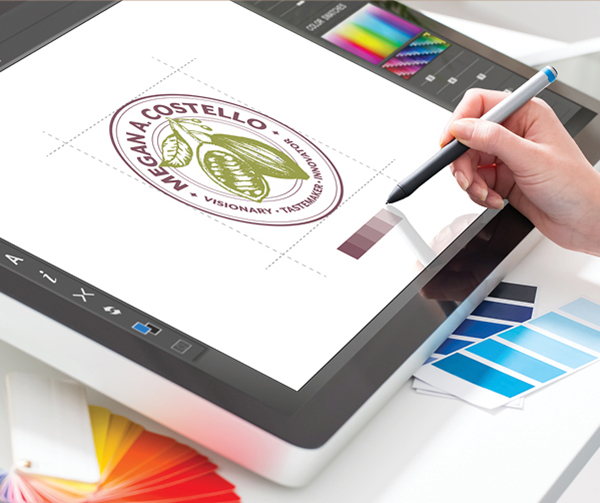
Have you ever wondered about the process of designing a logo? At CIM, the design process of creating a logo varies with every graphic designer. For some, it’s sketching concepts while listening to their favorite music. For others, it’s researching and exploring for creative ideas while sipping a strong espresso. Many steps are involved from concept to completion. Here’s a look behind the scenes…all the steps involved in creating a professional logo.
Step 1:
Creative Brief Discussion
The first step in designing a logo is to learn more about a business and its goals. Here are a few design information-gathering questions we always cover: What is the main purpose of the business? What is the brand’s personality or values? What are adjectives used to describe the brand? What kinds of customers or clients does the business have or want to attract? How do you want your customers to feel about the business? What are your preferences – font type, colors, fun versus formal? CIM aims to create a memorable visual representation for the business or service, so it’s critical to pull insights and information from each client.
Step 2:
Research the Industry
We research industry and competitor logos. This helps CIM designers get a sense of the environment the logo is going to live in and provides a framework for the next step of the process. Our designers ask themselves, "What colors, shapes, typography, graphic elements and taglines would make our client’s new logo powerful and effective?" They are especially cognizant of the psychology behind colors and shapes.
Step 3:
Start Sketching
After researching the industry, our designers at CIM will make rough sketches to explore any ideas that include logo, colors, typefaces and images. Sketching on paper is an effective brainstorming tool for designers to get the creative juices flowing and help see what elements work together or not.
Step 4:
Digitalizing the Design and Internal Review
Once the ideas are sketched, the best design concepts will be recreated in digital format using Illustrator. CIM designers will experiment with logo colors and typography to showcase the flat logo in variations that include mockups to see how it will work in real life. Then, the designer presents several strong logo options to a group of CIM team members for review and comment. Each logo’s concept is fully explained, and we share feedback to narrow the options.
Step 5:
Logo Presentation/Modifications
The refined logo options are presented and fully explained as to how and why they best represent the business or organization. Feedback is shared, and any desired edits (tweaking a color or graphic element, for example) are made until we have “the winner,” a solid logo that will withstand the test of time.
Step 6:
Final Logo Assets Delivery
Once the logo is finalized, CIM designers will organize and deliver the logo in multiple file formats that can be used for anything from marketing collateral to signage to the internet. We also provide a Brand Standards Guide that includes logo variations (like a black and white version) and color palettes so employees, partners and vendors can use the logo properly and consistently.
Since we believe brand is everything, a logo is certainly a core component. Creating a client’s perfect logo is a process, one that is critical to get right. We take pride in creating logos for brand new entities, and we also modify or update existing logos when that is appropriate. If you need any help with your brand/logo, we’d welcome a conversation.
"Logos are the graphic extension of the internal realities of a company."
~Saul Bass (graphic designer and Oscar-winning filmmaker whose work includes timeless logos for brands like Quaker Oats, Girl Scouts of America, United Way, AT&T and others)
A Focus Group of One
Each fall, we perform a number of Strategic Marketing Summits® for clients where we review the prior year and plan for the upcoming year. During those sessions, we discuss dozens of marketing tactics we have either employed or are considering for future initiatives.
We often look at (or propose) focus group research as an invaluable tool to evaluate and measure a firm’s branding and its current standing in the market relative to the competitive landscape, as well as evaluate potential future business actions. Over the course of orchestrating formal focus group research for 25 years, we have learned a “thing or two.” Let’s just say, the findings have often been completely unexpected, and in multiple cases, have provided insight and information that have ultimately redirected business investments that have saved, literally, millions of dollars in what would likely have otherwise been fruitless efforts.
On the topic of focus groups, I’d like to share with you exactly what we share with clients as we challenge them to review strategic marketing options. Here is a snapshot of verbiage from a post-Summit game plan document we created for a client in Reno.
As we touched on during the Summit, it is completely natural for any of us to have a "like that" or "don't like that" response to any particular tactic. While you may not like a printed newsletter in your mailbox, others may. You may be annoyed by social media, but others cherish the information and connection they gain from such interaction. Bottom line: Each individual is a focus group of one, so a tactic you personally may not like may still demonstrate value and be beneficial to brand and business building for others.
Performing well-planned focus group research is time extensive and a significant investment, but the payoff can be significant. Even if you do not broach that effort, you can benefit from not casting off marketing tactics merely because they wouldn’t “work” on you individually.
If you’d like to discuss a focus group research project for your firm, we’d welcome the opportunity.
"Marketing without marketing research is like driving with your eyes closed."
~Dan Zarrella
The Silver Lining of Rising Printing Costs
For more than a year, we (and our clients) have been experiencing rising costs for virtually everything we print for our clients. We’re not talking about periodic “slight price increases.” Commercial printing costs have been rising due to a number of factors, including basic supply and demand, paper pulp and end product shortages, shipping expenses, staffing issues and paper mill closures. But there’s some good news in the mix…read on.
It all began with the COVID shutdown, which sharply reduced use of certain paper types. With most schools and offices closed, paper use plummeted, and many factories suspended or reduced operations. Some factories reduced the production of printing paper to producing boxes as consumer demand shifted. This caused a ripple effect in raw materials used to make printing paper, and then worldwide shipping chaos added to the problem. And let’s face it, we all know what happened (and is happening again) with toilet paper and paper towel supplies. With the economic re-start, the supply chain ripples continue. Here are a few facts:
Paper pulp prices are up 20% over the past year.
The producer price index has risen more than 13% since December 2020.
Worldwide shipping backlogs are expected to last well into 2022, or longer.
The good news is that due to these issues, some are postponing their commercial printing orders. If your competitors are cutting these marketing efforts, the tactics you continue to implement will stand out all the more. We’ve proven over the course of decades that companies that continue to invest during rough economies come out far ahead of competitors that ceased or reduced their marketing efforts.
At CIM, we are doing all in our power to minimize commercial printing issues for our clients:
We have always worked with multiple printing companies to get several printing quotes. We weigh each job’s parameters against each printer’s experience and cost.
We are planning ahead. Print jobs that used to take 5 days may take 3 weeks, including jobs printed on “house paper stock,” as even that is experiencing uncertain availability.
We source alternate paper stock, when necessary, to keep a project on track.
This is a global issue, adding to the complexity of normalizing “the system.” Meanwhile, we’ll continue adjusting as needed and, in some cases, incorporate digital tactical options, where appropriate. Please let me know if you have any questions.
“Now supplies of certain [paper] grades are so tight that some commercial printers can’t get the paper they want at any price.”
~Kevin Mason, managing director for ERA Forest Products Research
Your Eggs + One Basket = A Very Bad Idea
This past Monday was a dark day for some of the largest social media platforms across the entire world. For more than 7 hours, Facebook, Instagram, and Whatsapp were completely down. While the details of what happened to the platforms are still a bit murky, what we do know is more than 2 billion people and more than 200 million businesses were unable to access the platforms, rendering their social media marketing efforts useless for the day.
Social media is a critical part of a company’s marketing mix, and this week’s outage reminded us of the importance of having a diversified marketing approach. More than 20 years ago, we developed and trademarked our Diversified Marketing Portfolio®. After surveying a client’s business goals, its mix of products and/or services and the competitive landscape, we review dozens of potential tactics before allocating an annual budget across multiple strategic tactics to ensure a diversified approach.
To learn more about the Diversified Marketing Portfolio®, click the button below.
We’ve all heard not to put “all of your eggs in one basket,” so be sure your marketing efforts are diversified and balanced. If you need help, we’re here for you…this is what we have done since 1996.
“Social media is a great way to grow your business, especially if you are doing so on a low budget. However, it isn’t the only way to grow your business…”
~Kimberly Studdard
What is your marketing strategy for 2022?
It’s that time of year, again. Fall is here, and it’s time to plan and budget for next year. Depending on how you do it, it can be a chore (one you keep pushing off) or it can be transformational, filled with excitement and opportunity.
For more than 20 years, we’ve performed Strategic Marketing Summits® for clients. We even trademarked it. These half-day sessions are designed to create an atmosphere where the past can be glanced, but more importantly, the future can be focused on intentionally and targeted for significant success.
Imagine a planning session wherein you’re not just choosing marketing tactics and assigning how much to spend on each, but you’re aligning specific business goals with right-fit tactics to help you reach and exceed those goals. Proper planning to align all marketing efforts with the best ROI in mind makes the difference between “just budgeting” and masterminding your efforts to build brand awareness, revenue and overall brand value.
If you’d like to learn more, here are a video and several testimonials about our Summits. Our retainer clients are having their annual Summits scheduled for this fall, and we’d welcome the opportunity to schedule one for you. More Summit details can be found here.
TESTIMONIALS
We explored our weaknesses and how they could be converted to opportunities for growth. The facilitation by CIM was most valuable – they got information from our team that we didn’t even know we had.
Robbie Graham, president, NTC Global Holding Group
We know we are putting our dollars where it gives us the greatest value. The Summit forced us to look down the road in scheduling our marketing program as our company evolves.
However you plan and budget for 2022, I implore you to do so strategically so you can realize the best results possible. Don’t dread your planning, but make it purposeful for you and your business.
“If you want to succeed and leave your competitors behind, you need great plans and even greater strategies.”
~Pooja Agnihotri, 17 Reasons Why Businesses Fail: Unscrew Yourself From Business Failure
Creating a Positive Company Culture
Whether you are the owner of a small business or the CEO of a large corporation, company culture is the backbone of a happy and successful work environment. It’s oftentimes elusive to define or describe, yet having a positive one is critical. While leadership cannot mandate a specific culture, it can foster an environment and take other steps for a positive culture to form or evolve organically. Here are some areas to consider.
EMPLOYEE WELLNESS.
No company can achieve a positive culture without having healthy and happy employees. In order for employees to contribute to a positive culture, they must be healthy physically, mentally, and emotionally. Managers should ensure that employees have the proper resources, tools, and healthcare opportunities they need to live their healthiest life, inside and outside of the workplace. It is important that as a manager, you seek new ways to lower employee stress, wherever possible, for them to work more efficiently.
GROW OFF YOUR CURRENT COMPANY CULTURE.
All companies have a culture, good or needing improvement. Understanding your culture’s “current state” is the starting point to, if needed, evolve that culture into one that’s more productive and satisfying for the entire team. You can create an anonymous survey to gauge team members’ view of the culture and/or simply have conversations or meetings about it. With those insights, once you have your culture defined and understood, you can focus on any needed changes for improvement.
CREATE GOALS.
Having a clear vision, mission, and goals that everyone is striving for is a key element of a positive company culture. Reaching goals and celebrating successes is another incentive to work towards, not just a paycheck.
WORKPLACE RELATIONSHIPS.
Last, but most importantly, fostering strong connections between employees is key to a positive company culture. When employees barely know each other and rarely interact, you will find it very difficult to have a positive workplace environment. Managers need to provide their employees with opportunities to have social interactions, at and outside of the workplace. Consider a weekly team meeting over lunch, happy hour, or even team building games… all will improve relationships between employees. Having strong relationships in the workplace will improve company culture and employees will be happier working with each other.
CIM Marketing Partners is always here to help. We are more than happy to discuss how creating a strong, positive company culture will result in productivity, healthy employees, and ultimately more success and high client satisfaction.
"Determine what behaviors and beliefs you value as a company, and have everyone live true to them. These behaviors and beliefs should be so essential to your core, that you don’t even think of it as culture."
~Brittany Forsyth
Taking Down Errant Reviews
In March of 2021, Google released a “Manage Your Reviews” tool, which gives Google My Business owners the ability to take down and see the status of each Google review on their page. This tool is convenient to help managers keep track of reviews that they have reported to Google for removal.
WHY IS THIS A GAME CHANGER?
There have been many fake, malicious, irrelevant or reviews posted to the wrong company on Google, resulting in a decrease in credibility and review ranking. The Manage Your Reviews tool, however, doesn’t work for business accounts with a large number of listings quite yet (like CIM who manages many Google My Business listings). This tool is ideal for small to medium businesses (SMBs). Although in its infancy and doesn’t work for everyone, this is a small step in the right direction of how Google manages review removal.
HOW DOES IT WORK?
You can find the Manage Your Reviews tool within the Google Help section. When you click on the tool, click on your business listing, which gives you the option to check the status of current review reports or to report a new review for takedown. When you click on “report a new review for takedown,” it will list all of the reviews in chronological order, with the option to report a problem on the right side of each review. You will then receive a shortlist of reasons why you wish to take down the review. After you click on the desired reason, the review will then be reported and you will additionally receive a follow-up email about the review.
MANAGE YOUR REVIEWS
If you would like to check the status of current review reports, you click on the status of current reviews button. A list of the reviews you reported will show in chronological order, and the status of each review will show on the right side, with it either saying the report has been approved and taken down, the decision is pending, or the report was reviewed and there was no policy violation. You have the ability to appeal a review if Google stated there was no policy violation and you believe there was. You then receive more in-depth options to state why you still wish to proceed with the removal of the review.
CONCLUSION
The “Manage Your Reviews” tool should ultimately work extremely well for businesses that receive fake or errantly posted reviews that either violate Google’s guidelines or are about a different company. The functionality of this tool to see the status of current review reports or report a review, although it only really works for SMBs that do not have a large number of listings.
STILL HAVE QUESTIONS ABOUT TAKING DOWN ERRANT REVIEWS?
CIM Marketing Partners is always here to help. We are more than happy to answer any questions you may have or help with the process of taking down errant reviews.
Customer service shouldn’t just be a department, it should be the entire company.
~Tony Hsieh, CEO Zappos
The 3 R's: Relationships, Referrals, and Reviews
I recently gave a presentation at Vista Consulting Team’s 2021 Annual Conference in Dallas. Vista is (obviously!) a consulting team that works with law firms across the country and Canada to improve their internal operations to maximize productivity and brand value, ultimately increasing performance and client satisfaction. To that end, I was invited to speak about strategic marketing tactics that lead to those outcomes. The presentation centered around relationships, referrals, and reviews, and how all three of these work together to build an established brand and build its new business pipeline. I’m happy to share with you some highlights of the presentation.
Relationships:
Relationship marketing can be defined as the ongoing process of identifying, establishing, maintaining, and enhancing successful relationships with clients/customers/stakeholders so that the objectives of all parties involved are met. This is done by mutual giving and fulfillment of promises.
By retaining and growing relationships, you can forge a stronger bond with clients and increase their satisfaction.
Through these interactions/touchpoints, you can cross-market products and services, making more people aware of your full offerings.
You can further develop your set of referral sources.
Your business development efforts can include ongoing communications with your audiences (think newsletters, emails and other touchpoints), networking, market research, trade and professional association involvement and inbound marketing efforts.
Referrals:
CIMply put, a referral is an act of sending someone to another person or place for advice, assistance, or other help. Key point: Referrals come from relationships…they don’t come from automated responses, AI, or bots. They come from truly being engaged P2P (people to people). By establishing and building genuine relationships with clients, referral sources, and others in and out of your industry’s sphere, you can send and receive referrals to and from trusted sources.
Reviews:
A review is a narrative report card that addresses the quality of a company’s services and products so that newcomers can make an informed choice as to whether it's a good match for their needs. There are so many review platforms to monitor and manage (Google, Yelp, Avvo, Facebook, etc.), and your customers or clients will largely decide where to post a review about you. Just because you may wish that your company didn’t have Yelp reviews, won’t make it so. The point is, with statistics like those below, reviews are real, they make an impact on your business and its potential clients and they need to be managed (responding to both the good and bad).
There are more than 75% of smartphone owners in the USA.
57% of consumers will only use a business if it has a 4 star or higher rating.
84% of people say they trust online reviews as much as a personal recommendation or referral.
Our best advice is to be proactive in your review management process. Designate someone within your company to monitor and reply to all posted reviews. We also suggest making it easy for your customers to give you a review, asking for reviews from satisfied customers, and repurposing great reviews on your website and social media. At CIM, we manage many clients’ review efforts (responding and soliciting) with services like BirdEye and Podium.
Embrace the 3 R’s and experience them working for you. If you’d like to discuss your approach or have the CIM team work with you to orchestrate your efforts, please let me know.
Nevada Business Awards
CIM was recently honored at Nevada Business Magazine’s Nevada Business Awards luncheon as a finalist in the “Others First: Philanthropy and Giving” category for DJs for PJs, the nonprofit organization it founded in 2001. DJs for PJs have collected more than 100,000 new pairs of PJs for children in need in Southern Nevada.
Create alliances: Everyone wins when you’ve got a network of quality referral partners.
~Unknown
Have You Cut the Cord? OTT (Over The Top) Advertising: CIMplified
What is OTT?
OTT stands for “Over The Top” and refers to streaming services that deliver content via the internet. These services are delivered “over the top” of another platform, hence the name.
Why is OTT a game changer?
Prior to high-speed internet, consumers would subscribe to and rely on either cable or satellite services to deliver programming. Today, users can sign up and subscribe to services like Netflix, Crackle, or Hulu (to name three) and access their offerings over the internet. The cable, satellite or other broadband providers only provide the internet connection and have no ability to control what is consumed. This separation has big implications for advertising.
OTT During COVID.
During the pandemic, streaming services saw a 50% increase every month (Bloomberg). In fact, 70% of people now have some type of streaming service in their homes (eMarketer). With statistics like that, OTT advertising is one of the fastest-growing mediums in advertising history. OTT streaming media services are device agnostic and range from TV apps to gaming consoles to mobile devices, and are available anywhere there is an internet connection. Many are now allowing users to download content and enjoy it in rural areas where internet service may not be available.
OTT and Audience Targeting.
The ability to deliver your targeted message to an audience that is closer to the buying decision is a benefit of OTT advertising. Targetability of OTT includes:
Intender Bases
Age
Geography
ZIP code
Mile Marker Radius
Gender
Income*
Credit Score*
* generated from self-reported user data
As more and more people become “cord cutters,” or supplement their current subscription services with streaming services, OTT should be another tool in your marketing toolbox.
Still have questions about OTT?
CIM Marketing Partners will be happy to answer any questions you might have.
Ready to get started with OTT?
CIM Marketing Partners is here to help. From budgeting recommendations to messaging to video creation to placement, we are your OTT one-stop partner.
Creative without strategy is called art. Creative with strategy is called advertising.