At CIM Marketing Partners, we believe in empowering our clients to maintain full control over their digital assets. We want to emphasize the critical importance of owning your own social media accounts.
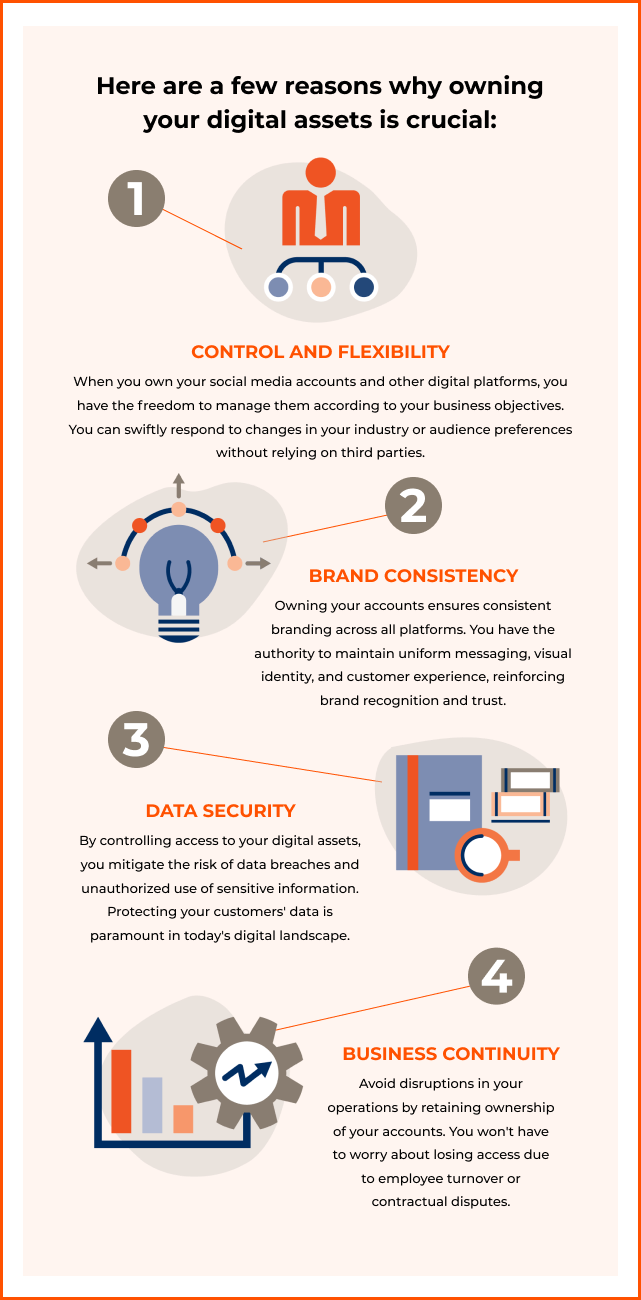
In today’s digital landscape, we've encountered situations where businesses faced significant setbacks due to lack of ownership over their online presence. One particularly alarming trend is the occurrence of former employees retaining control over crucial accounts, leaving the businesses they once served in a state of limbo. We've seen instances where ex-employees, whether terminated or having left voluntarily, have held business profiles hostage by refusing to allow access to vital accounts such as Google Business Profiles, websites and social media platforms.
This scenario not only disrupts your business operations, but also poses a serious threat to your brand reputation and customer engagement. Imagine being locked out of your own Google Business Profile, where potential customers are unable to find accurate information about your services or products. Or worse, picture your social media channels falling into the wrong hands, leading to unauthorized posts or even data breaches.
To safeguard your business against potential risks, we recommend taking these proactive measures to secure ownership of your digital assets:
Regularly review and update access permissions for all digital accounts.
Implement multi-factor authentication to enhance account security.
Document account credentials and access protocols in a secure location, accessible only to authorized personnel.
Conduct periodic audits to identify and address any unauthorized access or ownership issues.
At CIM Marketing Partners, we are committed to supporting you in protecting your digital presence.
The Future of Analytics is Here
Embrace Google Analytics 4 for Enhanced Insights
The countdown is on! Google has announced the sunsetting of Universal Analytics on July 1, 2023. If you haven’t set up, or if you haven't asked your webmaster to set up and install Google Analytics 4 (GA4) on your website, you only have a little bit of time to get it done. (Note: If CIM is your webmaster, rest assured we have been utilizing GA4 since its announcement running parallel to Universal Analytics on your site.)
While Google lists numerous reasons for the change, the biggest one is to comply with increasing regulations and laws regarding online user privacy. GA4’s enhanced data privacy features align with evolving regulations and user expectations. With GA4, businesses and marketers can easily configure data collection settings, ensuring compliance with privacy laws while maintaining accurate tracking. This helps foster trust among users and strengthens data governance practices.
This property will stop processing data starting July 1, 2023.
GA4 can bring numerous benefits to businesses of all sizes. With its advanced features and improved tracking capabilities, GA4 offers valuable insights that can drive data-informed decision-making and enhance overall marketing strategies.
1A major advantage of GA4 is its ability to provide a comprehensive view of user behavior across multiple devices and platforms. Traditional Google Analytics focused primarily on website data, but GA4 incorporates data from websites, apps, and other digital touchpoints, including social media platforms, email marketing, live chat, chatbots and voice assistants. This holistic approach enables businesses and marketers to understand the complete customer journey and make informed decisions to optimize user experience.
2GA4 has enhanced event tracking capabilities. Unlike its predecessor, GA4 places greater emphasis on event-based data collection, allowing businesses and marketers to track specific user actions, such as button clicks, form submissions, purchases, and video plays. This granular data empowers marketers to analyze user engagement and identify opportunities for improving conversion rates and user retention.
3GA4 introduces machine learning models that provide valuable insights without requiring complex configurations. The AI-powered insights feature in GA4 can automatically identify trends, anomalies, and opportunities within the data, saving time and effort for marketers. These insights can uncover valuable information about user preferences, allowing businesses to optimize their marketing efforts and tailor their campaigns to specific target audiences.
4GA4 offers a streamlined reporting interface that presents data in a more intuitive and user-friendly manner. The updated interface allows for easier customization of reports, making it simpler to extract the desired insights. The improved data visualization options and built-in data exploration tools further facilitate data analysis and interpretation. The one shortcoming is its reporting. The ability to easily print or create PDFs of its dashboard is limited. A third party platform like Looker Studio is recommended in order to format the data in an easy to digest format.
5GA4 allows businesses to future-proof their analytics setup. Google continues to invest in GA4 as its standard analytics platform by making it scalable, flexible, compatible with evolving standards, advancing machine learning, and data governance and security.
The benefits of switching to GA4 are clear. Its comprehensive view of user behavior, enhanced event tracking capabilities, AI-powered insights, data privacy features, streamlined reporting interface, and future-proofing potential make it a valuable tool for businesses and marketers seeking to leverage data for informed decision-making and marketing success.
The above information offers a glimpse of the depth of details and ever-changing digital landscape our team lives in each day. If you’d like to discuss assistance with your marketing needs, please reach out to me at dneighbors@cimmp.com or 702.944.2464. Thank you.
Simplify Event Planning with Our Innovative Event Management Solutions
Anyone who is in charge of putting together even a small event quickly learns the task is much more substantial than one might think. There is a lot to consider, and dozens upon dozens of details to be thought through and planned.
Since our founding more than 26 years ago, we have conceived and planned hundreds of events for our clients, ranging from open houses to full-blown national conferences with hundreds of attendees. We are proud to have pulled off brand building, successful events that have been meaningful to attendees and the clients themselves.
Now, we’ve opened up our event planning and management services to anyone.
Please visit our new event services landing page on our website to learn more about how we approach planning an event and examples of all the facets of making the event a complete success.
If you’re considering an event of any kind, our expert event management team can help you unlock the full potential of that event. If you have any questions or would like to learn more, please reach out to me.
“To create something exceptional, your mindset must be relentlessly focused on the smallest detail.”
~Giorgio Armani
Behind the Scenes: The Process of Designing a Professional Logo
Have you ever wondered about the process of designing a logo? At CIM, the design process of creating a logo varies with every graphic designer. For some, it’s sketching concepts while listening to their favorite music. For others, it’s researching and exploring for creative ideas while sipping a strong espresso. Many steps are involved from concept to completion. Here’s a look behind the scenes…all the steps involved in creating a professional logo.
Step 1:
Creative Brief Discussion
The first step in designing a logo is to learn more about a business and its goals. Here are a few design information-gathering questions we always cover: What is the main purpose of the business? What is the brand’s personality or values? What are adjectives used to describe the brand? What kinds of customers or clients does the business have or want to attract? How do you want your customers to feel about the business? What are your preferences – font type, colors, fun versus formal? CIM aims to create a memorable visual representation for the business or service, so it’s critical to pull insights and information from each client.
Step 2:
Research the Industry
We research industry and competitor logos. This helps CIM designers get a sense of the environment the logo is going to live in and provides a framework for the next step of the process. Our designers ask themselves, "What colors, shapes, typography, graphic elements and taglines would make our client’s new logo powerful and effective?" They are especially cognizant of the psychology behind colors and shapes.
Step 3:
Start Sketching
After researching the industry, our designers at CIM will make rough sketches to explore any ideas that include logo, colors, typefaces and images. Sketching on paper is an effective brainstorming tool for designers to get the creative juices flowing and help see what elements work together or not.
Step 4:
Digitalizing the Design and Internal Review
Once the ideas are sketched, the best design concepts will be recreated in digital format using Illustrator. CIM designers will experiment with logo colors and typography to showcase the flat logo in variations that include mockups to see how it will work in real life. Then, the designer presents several strong logo options to a group of CIM team members for review and comment. Each logo’s concept is fully explained, and we share feedback to narrow the options.
Step 5:
Logo Presentation/Modifications
The refined logo options are presented and fully explained as to how and why they best represent the business or organization. Feedback is shared, and any desired edits (tweaking a color or graphic element, for example) are made until we have “the winner,” a solid logo that will withstand the test of time.
Step 6:
Final Logo Assets Delivery
Once the logo is finalized, CIM designers will organize and deliver the logo in multiple file formats that can be used for anything from marketing collateral to signage to the internet. We also provide a Brand Standards Guide that includes logo variations (like a black and white version) and color palettes so employees, partners and vendors can use the logo properly and consistently.
Since we believe brand is everything, a logo is certainly a core component. Creating a client’s perfect logo is a process, one that is critical to get right. We take pride in creating logos for brand new entities, and we also modify or update existing logos when that is appropriate. If you need any help with your brand/logo, we’d welcome a conversation.
"Logos are the graphic extension of the internal realities of a company."
~Saul Bass (graphic designer and Oscar-winning filmmaker whose work includes timeless logos for brands like Quaker Oats, Girl Scouts of America, United Way, AT&T and others)
Don't Let Analysis Paralysis Take Over Your Marketing
Do we need some Public Relations (PR) activity? Someone asked me why she couldn’t find us on Facebook. I feel like we’re being left behind in social media. Should we do that sponsorship? Maybe we should do something. I think we need a plan. It’s time to move the dial on our business plan…wait, we haven’t updated “the plan” since 2016. Even though the new year is underway, it’s not too late to strategize and implement a proactive marketing plan.
We hear it routinely when meeting with prospective clients. Everyone seems to know they could benefit from marketing and PR efforts, but often they’re not sure what to do, how to do it, how much they need to invest to make it worthwhile, who should be involved and what, exactly, the plan should be.
What we’ve done for years is proven to work, year after year, for clients who stay the course and invest in marketing in the good times and bad. Here are some START NOW steps to take:
Start being clear on who needs to be involved in decision-making regarding marketing/PR activities. Figure it out! (Too many cooks in the kitchen applies…)
Start having a marketing budget to invest properly, and regularly.
Start getting yourself out of analysis paralysis mode and decide what to do. Get help from professionals who can help you evaluate your business position and goals to get moving on the right, consistent pathways.
Start strategically approaching marketing with right-fit tactics instead of doing random acts of marketing. Have a plan and operationalize it.
Start figuring out what YOU will be doing from this point forward instead of worrying about what everybody else is doing.
Once you have a solid plan and it’s put in motion, it’s amazing how much easier it is to then tackle new potential marketing activities as they come along. You’ll be doing marketing and enjoying the measurable results. You’ll be building the value of your company and its brand. You’ll be much more active in determining the future of your company instead of just letting things happen to your company. And…you will have shed that analysis paralysis that has frozen you for who knows how long.
Quote of the week:
If you spend too much time thinking about a thing, you’ll never get it done.
Bruce Lee
Only 58 Working Days Until Christmas!
We’re getting close to that time of year when many companies reach out to those who mean the most to them: Their clients, their referral sources, and their preferred vendor partners. For some, it means sending a holiday card (physical or e-card) and/or a holiday gift.
If you choose to send a gift, here are some tips to keep in mind:
Choose a single gift or a collection of smaller items that are meaningful and useful.
You may want to create a theme and follow that, including on the card or in messaging that accompanies the gift.
Many companies create several levels of gifts (with corresponding costs), with perhaps the highest level going to your most significant clients or referral sources, a mid-range gift for moderate-size clients and something nice for others.
We do not recommend over segmenting into too many groups, as this becomes cumbersome and more difficult to orchestrate.
Presentation is important.
Whether hand-delivered or mailed, take time to wrap or package it so it makes a nice impression on the recipient.
Your firm logo may or may not have a place.
On sticky notes and low-end pens, sure, your logo is fine. Some of the nicest, longest-lasting and most used items I’ve received over the years do not have logos on them, but you can bet I remember who gave me those items (a leather padfolio or a business travel bag, for example).
In advertising, we try to stand out while avoiding the fray, instead showing up when there’s less competition for one’s attention.
After Thanksgiving, you may have noticed your company break room becomes filled with a number of incoming gifts, further blurred by your own extra busyness of the season. That’s why since I started my company in 1996, we’ve been sending holiday cards and gifts each November just before Thanksgiving.
A Note About Food Gifts and COVID
If you’ll be giving food items to a group or an entire office, make sure those items are individually wrapped – forego the whole cake this year, instead opt for individually wrapped or packaged serving sizes. It might increase cost a bit, but this will ensure your holiday treat will be enjoyed by the recipients.
We just entered October, so it’s time to make up your lists and gather your thoughts on how you’ll be touching those you care about and appreciate. If you need any assistance, please reach out.
Quote of the week:
The excellence of a gift lies in its appropriateness rather than in its value.
Unknown
So, You Think You Know Your Target Audience...
A foundational mistake is assuming that you KNOW your clients, that is, what they want, what they expect, how they view your brand, etc. Sure, you have a good idea, but it goes deeper than that. One marketing tactic that we have always supported is focus group research. Let’s briefly review what they are and how they are orchestrated, as well as share some real-life examples we have “lived” in years of performing this research.
Focus Groups Defined
Between 10-12 individuals are recruited to physically meet at either a research facility or other suitable location to gather in a room to discuss a topic and share their insights. These “respondents” or “participants” may or may not know who is funding the research. For example, the group could be current and/or past clients of a particular company and they would, obviously, find out who is behind the research. Conversely, if you’ve gathered a group to discuss what financial management software clients need, want, and use (because you sell such software), the respondents would likely not be told which company is behind the research. Detailed, non-leading questions and discussion points are painstakingly outlined and used by a facilitator during the two-hour session.
What Is Learned And How is It Used?
CIMply put, a plethora of useful information is gathered. Companies learn specific buying habits, how buying decisions are made, how their companies and competitors are viewed (branding), what consumers want and need in services/products, and on and on. Focus group findings can be used across the board at a given company:
Where and how to most effectively advertise and market the company
What product or service differentiators to include, expand or promote
Which product or service features and benefits to expand or integrate
How to steer the company’s strategic plan and its diversified marketing approach
Wow Moments, And “Great Ideas” Gone Awry
We’ve done a number of focus groups in multiple states and industries, and there have been wow moments at each. A sampling:
A large financial services firm envisioned creating a “one-stop-shop” under its roof, bringing together CPAs, attorneys, and financial advisors to jointly share information and services about their clients. When we pulled together a group of their actual current clients (all high-net-worth individuals), the idea was outlined (with the perceived benefits), and within minutes, it was clear that there was huge resistance to the idea. The overwhelming response? “I don’t want my CPA to be talking to my lawyer or my financial advisor. I would pull my accounts if someone wanted me to work that way.” Ultimately, the plug was pulled on what would have been a complex and expensive business model to create, saving countless dollars and heartache.
A decades-old company in the automotive services realm had us hold three focus groups to identify motivators for choosing one company over another. The unexpected twist was that the majority of the respondents said they had never heard of our client’s company when we discussed the brand image of several competitors and our client’s company. Turns out, when the client had reached the pinnacle of name recognition in the late 1990s, it pulled most marketing. “Everybody knows us now, business is good. Let’s cut marketing.” What they didn’t take into account were the 6,000 people per month moving into the city, people who had no way of knowing about this established brand.
The information that can be gathered from this formal research can be incredibly useful. We have yet to hold a focus group that didn’t ultimately pay for itself many times over by strengthening the company, increasing revenue, improving the client experience/satisfaction, etc. If you’d like to discuss investing in focus group research, we’ll share all the details and work with you to uncover hidden gem information.
Quote of the week:
Research is creating new knowledge.
Neil Armstrong
Managing Your Brand: Design 101
It’s all around us: Bad graphic design. Whether on a billboard, on a website, or in your mailbox, you know it when you see it. One of my team members even keeps a “Marketing Mishaps” folder filled with examples from over the years, just for fun. Thankfully, there are some rules of thumb to help you avoid design blunders and properly manage your brand. Here are a few:
Trust a talented designer. You’ve invested a lot in your brand, the visual part of it. Your logo, tagline, branding elements, colors, and brand standards/usage guidelines are the foundation pieces. With those in place, it’s up to a pro to know how to use them as a part of extending your brand, creating your brand presence effectively. A designer gets to understand your brand and knows how to artfully balance design and verbiage to propel your message.
Less is more. The recipient will remember your message when you communicate it CIMply and clearly. You don't have to display all brand elements in every instance just because you have them.
While you may have built a treehouse in the backyard, you wouldn’t try to build your new home yourself. True designers have innate talent and training to use tools to pull it all together.
Stand out. When looking head to head at competing products and services, you want to best the competition’s offerings. How you do this is by having well-conceived, graphically pleasing designs that reach this goal. A designer knows how to accomplish this for you.
Don’t forget the family. Your brand family, that is. Your brand footprint is ever-expanded by using your brand elements everywhere you have a presence. Your printed marketing materials should match your digital marketing efforts. Whether one visits your website, views your social media pages, or receives an email or actual mailpiece from your company, it should look and feel like it’s something about your company.
Brand consistency doesn’t happen by itself, but must be managed, and that ultimately helps lead to a higher trust in a brand: “I know this company, I recognize this company, I like doing business with this company.” Think about Apple, for example. When this company touches you with a message, do you almost instantly know it’s Apple?
Investing in good design pays for itself in spades through building your competitive advantage, elevating your company’s products and services above others, increasing actual sales and revenue and, ultimately, driving marketing results. Step one: Make sure it’s being effectively led and managed by someone or a team you trust.
Quote of the week:
…knowing how to use a design or art software doesn’t make you a designer.
Adri M.
Watch Now vs. Read More
For years, we’ve been encouraging and helping our clients to incorporate video content into their marketing mix – website, email marketing, social media platforms, and online advertising. Research continues to show an increase in the number of people who, given the option of watching a video or reading information, choose video. A few statistics:
Over 80% of all traffic will consist of video by 2021. ~Cisco
81% of businesses are now using video for marketing. ~Hubspot
90% of consumers claim a video will help them make a purchasing decision. ~Social Media Today
In addition to well-written content, video is another touchpoint with significant benefits. Videos are natural attention grabbers. Their movement draws people in to watch and learn more. Search engines love video and typically return search results of video higher within the rankings, making your website (and its videos) more likely to be discovered.
What types of videos might you consider creating?
Talking heads or interviews:
These videos can be a person simply talking about your company, a service or practice area, or two people discussing a particular topic. The content should ultimately focus on the viewers, that is, offering to help them with something they need, or providing a solution or answers.
Explainers or “doodle”:
These animated or sketch videos literally draw a picture while telling a story, describing how something works or walking the viewer through a process. Keywords typically appear within the video, which is narrated throughout.
Testimonials:
These videos feature actual customers or clients talking about their experiences in working with your company.
Demonstrations:
These videos feature the use of a product or “how-to” to illustrate how something is done or used. These are along the lines of explainer videos, but used when providing a detailed walkthrough on using a product or navigating a process.
The most impactful videos are engaging, entertaining and informative. While a mix of video lengths is appropriate (longer for certain purposes), with the shorter attention span of many people today, short videos (under 90 seconds) have a higher chance of being viewed to the end. Even shorter videos (under 15 seconds) may be required for online advertising to very quickly make a point and encourage a click-thru to your website to learn more.
If your marketing efforts don’t include video, it’s a missed opportunity to connect with your target audiences, to let them hear and see what you do and how you help clients. If you would like to discuss how video can be effectively created and incorporated into your marketing efforts, please reach out.
Quote of the week:
Business decision makers LOVE online video because it gives them the most amount of information in the shortest amount of time.
Robert Weiss, Use YouTube Video Marketing to Generate Leads, Awareness and Customers
Getting Social With It
Are you feeling overwhelmed by social media? For businesses, over the past few years, it has become a necessity to establish and maintain a presence on various social media platforms. Especially now, in a time where an in-person conversation is not always possible, many have turned to social media as a way to communicate directly with their audience. Some companies have reluctantly been forced into social media, simply because this is where people are these days. Others have embraced these new communication channels as additional avenues to build awareness and attract clients. Here are a few “lessons learned” from our team, who is immersed in the social media landscape. They have become guiding principles to avoid becoming overwhelmed, allowing us to focus resources most effectively.
CHOOSE WISELY:
For the past few years, my social media team and I have attended Social Media Marketing World, one of the largest social media conferences in the country. From them, we learned that you fail at social media by trying to be active everywhere and not giving any of them your all. Instead, you should pick one or two and be REMARKABLE on those platforms. Choose the ones that make sense for your company. Where are your current and potential clients interacting? What are their demographics? Match your efforts to your audiences.
MAINTAIN ACTIVITY:
If you’re going to have a presence on a particular platform, do so with intent. Beyond building out your landing page to reflect (graphically and content) your brand, plan regular new content and posts, and stick with it. Avoid the bad impression that results from a client or prospect seeing that you haven’t had any activity in the recent past. Build out a content calendar for posts and react/reply to posts of others on your pages.
PROVIDE VALUE:
Visitors to your pages should experience content that resonates. There should be a good mix of posts: Consider product/service updates, testimonials, team member profiles, client stories, and special events. Each post should connect in some way with visitors, making them feel a part of your company. Your presence on social media platforms is an opportunity to further enhance and manage your overall brand and its reputation. Planning and managing your efforts will help you avoid feeling overwhelmed and overworked.
Quote of the week:
We don't have a choice on whether we do social media, the question is how well we do it.