PPC for Personal Injury Law Firms

Personal injury keywords are among the most expensive in all of paid search. A click on "car accident attorney" or "truck accident lawyer" in a major market can cost well over $200, and in the most contested markets the figure climbs past $400. At those prices, the difference between a well-managed campaign and a poorly managed one is not a few percentage points. It is whether your firm makes money or quietly bleeds it.

Pay-per-click advertising can fill a personal injury firm's pipeline within days, which is its great strength. But the same economics that make it fast, also make it punishing for mistakes. This page explains how PPC works for injury firms, where the money leaks, and what disciplined management looks like.

CIM Marketing Partners manages paid search for law firms with one goal: a lower cost per signed case. To review your current campaigns or build new ones, call 702.944.2464 or email info@cimmp.com.

Why Personal Injury PPC Costs So Much

The cost of a click is set by an auction, and the auction reflects what a click is worth. Because one signed personal injury case can generate tens or hundreds of thousands of dollars in contingency fees, firms bid aggressively. A firm that signs one in twenty leads, with each case worth $40,000 in fees, can rationally pay a great deal for each of those twenty clicks. That economic reality pushes injury PPC into a tier of its own.

The implication is straightforward. When clicks are this expensive, waste is not a rounding error. A campaign that shows your ad to people searching for legal jobs, law school programs, or how to handle a claim without a lawyer is spending hundreds of dollars to reach people who will never sign. Tight management is not optional at these prices.

Google Ads Search Campaigns

Standard Google search ads appear at the top of results when someone searches for an injury lawyer. Running them profitably for a personal injury firm comes down to a few disciplines done relentlessly.

Keyword targeting has to match high-intent searches and exclude the rest. Someone searching "hired a lawyer after car accident" is a client; someone searching "how much do car accident lawyers make" is not. Negative keyword lists, the terms you tell Google to never show your ad for, are where injury campaigns live or die. A neglected negative list can waste a third of a budget on irrelevant clicks.

Ad copy and extensions need to communicate trust and urgency in the small space Google allows: no fee unless you win, free consultation, available 24/7, real results. And the landing page the click leads to has to do its job, which is the most overlooked part of the entire system.

Local Services Ads and Google Screened

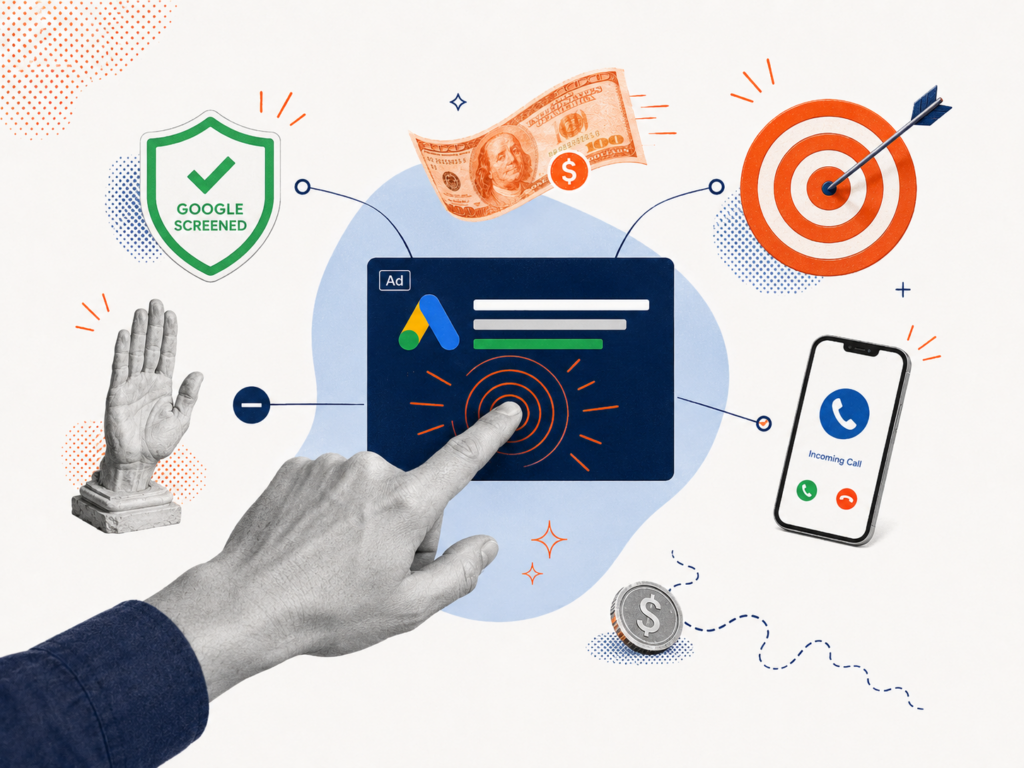
Google's Local Services Ads sit above everything else on the page, including standard search ads, and carry the green Google Screened checkmark that signals Google has verified the firm. For law firms, Google Screened requires passing background and license checks, which builds instant credibility with searchers.

The key difference from standard Google Ads is the pricing model. Local Services Ads charge per lead, not per click, and you can dispute leads that are clearly not legitimate. For many personal injury firms, Local Services Ads deliver some of the highest-intent, best-converting leads available, and they belong in almost every injury firm's paid mix alongside standard search.

The Landing Page Problem

Most firms pour money into the click and ignore where it lands. Sending paid traffic to a generic homepage is one of the most common and expensive mistakes in law firm PPC. The person who clicked an ad for "motorcycle accident lawyer" should land on a page about motorcycle accidents, with a clear headline that matches their search, proof the firm handles these cases, and an obvious way to make contact in one step.

A dedicated landing page built for the campaign, fast, focused, mobile-first, and free of distractions, routinely converts at several times the rate of a homepage. When clicks cost $200, doubling the conversion rate effectively halves the cost per signed case. Landing page quality is often the highest-leverage fix in an underperforming campaign.
PPC for personal injury law firms

Call Tracking and Intake: Where Budgets Are Won or Lost

Personal injury leads convert by phone far more than by form, often in the moment, often while the person is still upset. If a paid click generates a call that goes to voicemail, the money is gone and the case goes to the firm that answered. Call tracking tools like CallRail attribute every call to the campaign, keyword, and ad that produced it, which is the only way to know what paid search is actually generating.

But tracking the call is not enough. The call has to be answered, fast and well. The most sophisticated campaign in the world cannot fix an intake team that misses calls after 5 p.m. or lets leads sit overnight. CIM connects paid media to intake and follow-up so the leads your budget produces become signed cases instead of missed opportunities.

Measuring PPC the Right Way

The only paid search metrics that matter for a personal injury firm are cost per signed case and return on ad spend against actual fee revenue. Clicks, impressions, and even cost per lead are inputs, not outcomes. A campaign with a high cost per click can still be the most profitable one you run if those clicks sign cases, and a cheap campaign can lose money if the leads never convert.

Measuring this requires connecting paid spend, call tracking, and your case management system, then reporting on signed cases by source. CIM builds this reporting in Google Looker Studio so each month's review is a conversation about cases and revenue, with the budget moving toward whatever is producing signed clients and away from whatever is not.

Frequently Asked Questions About Personal Injury PPC

How much do personal injury law firms pay per click on Google Ads?

Personal injury keywords commonly cost $100 to $400 or more per click in competitive markets, making them among the most expensive in all of paid search. The exact cost depends on the market, the specific keyword, and the level of competition. Because clicks are so expensive, tight campaign management and strong landing pages are essential to keep cost per signed case reasonable.

Are Local Services Ads better than Google Ads for personal injury firms?

Local Services Ads and standard Google Ads serve different roles, and most personal injury firms benefit from running both. Local Services Ads appear above everything else, carry the Google Screened trust badge, and charge per lead rather than per click, which often produces high-intent, well-converting leads. Standard search ads offer more control and reach, so the strongest paid programs use them together.

Why is my law firm's PPC not producing signed cases?

The most common causes are wasted spend on irrelevant searches, sending clicks to a generic homepage instead of a dedicated landing page, and an intake process that misses or mishandles calls. Because personal injury clicks are so expensive, any of these issues can make a campaign unprofitable. The fix usually starts with a tighter negative keyword list, purpose-built landing pages, and call tracking tied to intake.

How do I measure whether my law firm PPC is profitable?

Measure cost per signed case and return on ad spend against actual fee revenue, not clicks or cost per lead. This requires connecting your ad spend, call tracking, and case management system so you can see which campaigns produce signed clients. If your reporting only shows clicks and leads, you cannot tell whether your paid search is making or losing money.

Stop Overpaying for Cases You Don't Sign

CIM Marketing Partners manages Google Ads and Local Services Ads for law firms with a single focus: lowering your cost per signed case. We tighten targeting, build landing pages that convert, connect call tracking to intake, and report on revenue. To audit your current campaigns or build new ones, contact CIM Marketing Partners today.
Personal Injury Law Firm Marketing: The Complete 2026 Guide

Personal injury is the most competitive corner of legal marketing, and it isn't close. A single click on a Google search ad for "car accident lawyer" can exceed $300 in major markets. Television, billboards, and radio are saturated with firms spending seven figures a year. New competitors enter every quarter, and the firms that already dominate spend aggressively to stay on top. For a personal injury firm trying to grow, the question is not whether to market. It's how to market without lighting money on fire.

This guide covers what actually works in personal injury law firm marketing right now: the channels that bring in signed cases, how to budget across them, where most firms leak money, and how to measure whether any of it is paying off. It is written for the people who sign the checks, managing partners and firm owners, not for marketers who already speak the language.

CIM Marketing Partners has built and grown law firm brands for thirty years, including personal injury firms that have gone from a few cases a month to market leadership. If you want to talk through your firm's specific situation, contact CIM Marketing Partners today.
Why Personal Injury Marketing Is Different From Every Other Practice Area

Most legal marketing advice treats all practice areas the same. Personal injury breaks that advice for three reasons.

First, the cost of acquisition is brutal. Because a single signed case can be worth tens or hundreds of thousands of dollars in fees, firms bid those economics into every channel. That pushes pay-per-click costs, billboard rates, and television buys far above what a family law or estate planning firm would ever pay. You are competing against firms that can afford to lose money on a click because one case pays for a thousand of them.

Second, the buying decision is fast and emotional. Someone injured in a crash on the I-15 is not researching for weeks. They are looking for help within hours or days, often in pain, often scared, often while still in a hospital bed. The firm that shows up first, looks trustworthy, and makes contact easy tends to win. Speed of intake matters as much as visibility.

Third, trust is everything and it is hard to fake. People hand a personal injury firm their medical records, their financial future, and their story. Reviews, reputation, real case results, and a brand that signals competence carry more weight here than in almost any other legal niche. A polished brand is not vanity. It is a conversion tool.

The Channels That Actually Drive Signed Cases

There is no single channel that wins personal injury marketing. The firms that grow predictably run several in parallel and feed leads into a tight intake process. Here is how each one earns its place.

Organic SEO and Content

Search engine optimization is the long game, and it is the channel with the best economics over time. When your firm ranks organically for "car accident lawyer" in your city, you pay nothing per click, and the traffic compounds month over month. The catch is that it takes time, usually six to twelve months to see real movement in a competitive market, and it requires consistent content built around how injured people actually search. We cover this in depth in our guide to SEO for personal injury lawyers.

The rise of AI-powered search is worth paying attention to as well. When someone asks Google's AI Overview, ChatGPT, or Perplexity which personal injury lawyer to call, the firms that surface in those answers are not winning on a separate track. They are winning because they already have strong organic rankings, authoritative content, and the right structured data in place. If your SEO foundation is solid, you are already doing most of what it takes to show up in AI-generated results. For a deeper look at optimizing specifically for these platforms, see our guide to GEO for personal injury lawyers.

Google Ads and Local Services Ads

Paid search puts your firm at the top of the results page immediately, which matters when someone needs a lawyer today. Standard Google Ads run on a cost-per-click auction that, for personal injury terms, is among the most expensive in all of advertising. Google's Local Services Ads, the listings with the green Google Screened checkmark that appear above everything else, charge per lead rather than per click and tend to convert well for injury firms. Both require active management to avoid waste. We break down the numbers in our guide to PPC for personal injury law firms.

Google Business Profile and Local SEO

When someone searches "personal injury lawyer near me," Google shows a map with three local listings before any organic results. Earning one of those three spots is one of the highest-return things a firm can do, and it is driven by your Google Business Profile, your review volume and rating, your proximity to the searcher, and the consistency of your firm's name, address, and phone number across the web. Many firms never optimize this and leave the map pack to competitors.

Reviews and Reputation

Review count and average rating influence both your map pack ranking and your conversion rate. A firm with 200 reviews at 4.9 stars will out-convert a firm with 12 reviews at 4.6, even if they rank in the same position. Building a systematic review-generation process, asking every satisfied client at the right moment, is one of the cheapest and most effective things a personal injury firm can do.

Brand, Video, and OTT

As a firm grows, brand advertising starts to matter. Connected TV and over-the-top streaming ads now let firms run television-style spots targeted to their exact market at a fraction of broadcast cost. A recognizable brand lifts the performance of every other channel: people click the search ad they recognize, choose the firm they have seen, and trust the name they remember. This is where full-service capability separates the firms that plateau from the firms that keep scaling.

Intake and Marketing Automation

This is the channel firms forget, and it is where most marketing budgets quietly die. A lead that calls at 7 p.m. and reaches voicemail is a signed case for your competitor. Marketing automation, call tracking, and a responsive intake team turn the leads your marketing generates into actual clients. If your intake answers every call, follows up fast, and never lets a lead go cold, your entire marketing budget works harder.

How Much Should a Personal Injury Firm Spend on Marketing?

There is no universal number, but there are useful anchors. Established firms in competitive markets commonly invest somewhere between 10 and 20 percent of gross revenue into marketing, and aggressive growth-stage firms go higher. What matters more than the percentage is the allocation and the discipline behind it.

A reasonable starting framework for a growth-focused firm splits the budget across three buckets: a foundation layer that runs regardless of the month, an acquisition layer that scales with appetite for new cases, and a brand layer that compounds over time. The foundation covers your website, SEO/GEO, Google Business Profile, and review generation. The acquisition layer covers Google Ads, Local Services Ads, and any paid social. The brand layer covers video, OTT, and the creative that makes everything else convert better.

The mistake firms make is spending everything on the acquisition layer because it produces leads this week, while starving the foundation and brand layers that lower the cost of every lead next year. Paid ads without SEO means you rent your visibility forever. Paid ads without a strong brand means you pay full price for every click because nobody recognizes you.

Measuring What Matters: Cost Per Signed Case, Not Cost Per Lead

Most agencies report cost per lead because it looks good. A personal injury firm should care about cost per signed case and, ultimately, return on ad spend measured against actual fee revenue. A channel that produces cheap leads that never sign is more expensive than a channel that produces costly leads that convert.

To measure this honestly, you need three things connected: lead tracking that attributes every call to the channel that produced it, a case management system that records which leads sign, and reporting that ties marketing spend to signed cases by source. CIM builds this measurement layer for clients using tools like CallRail for call attribution and Google Looker Studio for reporting, so the conversation each month is about signed cases and revenue, not vanity metrics.

Once you can see cost per signed case by channel, the budget decisions make themselves. You move money toward what signs cases and away from what doesn't. Without that visibility, you are guessing, and in a market where a click costs $300, guessing is expensive.

Personal Injury Law Firm Marketing

The Full-Service Advantage in Personal Injury Marketing

Many personal injury firms hire a digital-only agency for SEO and ads, a separate company for their website, a freelancer for video, and handle PR and events themselves. Every handoff between those vendors is a place where the brand drifts, the message splits, and the reporting falls apart.

A full-service partner runs strategy, brand, website, SEO, paid media, content, video under one roof, with one team accountable for one number: signed cases. That coordination is not a luxury. In a channel-by-channel fight against firms with deep pockets, having every piece pulling in the same direction is often the difference between growth and a plateau. We explain when this matters in our comparison of [full-service versus digital-only marketing agencies].

Frequently Asked Questions About Personal Injury Law Firm Marketing

How much does personal injury law firm marketing cost?

Most established personal injury firms invest 10 to 20 percent of gross revenue into marketing, though growth-stage firms often spend more. The right number depends on your market's competitiveness, your growth goals, and your current case volume. What matters more than the total is allocating it across SEO, paid media, and brand rather than putting everything into ads that stop working the moment you stop paying.

How long does it take to see results from personal injury marketing?

Paid channels like Google Ads and Local Services Ads can generate leads within days of launch. SEO and organic content typically take six to twelve months to produce meaningful ranking improvements in a competitive personal injury market. A sound strategy runs paid channels for immediate cases while building SEO and brand for lower-cost growth over time.

What is the most effective marketing channel for personal injury firms?

There is no single best channel; the firms that grow predictably combine several. Google Local Services Ads and the local map pack tend to deliver the highest-intent leads, organic SEO delivers the best long-term economics, and a strong brand lowers the cost of every other channel. The intake process that converts those leads into signed cases matters as much as any single channel.

Should a personal injury firm hire one agency or several specialists?

A single full-service partner generally outperforms a patchwork of specialists for personal injury firms because the channels reinforce each other and need to share one strategy and one message. When SEO, paid media, brand, and intake are managed by separate vendors, coordination breaks down and reporting becomes impossible to trust. One accountable team focused on signed cases is usually the better structure.

How do I know if my marketing is actually working?

Track cost per signed case by channel, not cost per lead or clicks. This requires call tracking that attributes every inquiry to its source, a case management system that records which leads sign, and reporting that connects marketing spend to actual fee revenue. If your current reporting only shows impressions, clicks, or leads, you cannot tell which channels are profitable.

Grow Your Personal Injury Firm With a Partner That Has Done It Before

CIM Marketing Partners has spent nearly thirty years building and growing law firm brands, including personal injury firms that became market leaders. We run strategy, brand, website, SEO, paid media, content, and intake support as one coordinated team, measured on signed cases. If you want a marketing partner who reports on revenue instead of vanity metrics, call 702.944.2464 or email info@cimmp.com to start the conversation.

Are You Missing LinkedIn Opportunities?

It remains one of the strongest platforms for business development, yet most users barely scratch the surface.

When your profile isn’t clear, your activity is inconsistent or your message doesn’t reflect your expertise, you lose visibility with people who are already looking for the services you offer.

LinkedIn rewards clarity and consistency. A polished profile builds credibility. Steady engagement keeps you top of mind. Together, they help attract better connections and stronger referral opportunities.

If it’s been a while since you reviewed your presence, now is the time. The firms that invest in LinkedIn are seeing the leads and visibility that others miss simply because they aren’t showing up.

Our team offers LinkedIn audits and training that help professionals strengthen their presence and avoid losing out on opportunities that should be theirs.

The Google Search update everyone is talking about, and what it actually means

At its I/O 2026 conference, Google introduced a redesigned search box, a new default AI model, and a feature called "information agents" that will monitor the web on a user's behalf around the clock. AI Mode, the conversational search experience Google launched a year ago, has already crossed one billion monthly users.

We wanted to send a quick, plain-language read on what this actually means for your business, because the headlines this week have been loud and not always accurate.

The most important takeaway is not the technology. It is the behavior shift.

People are searching differently. They are typing longer, more conversational questions. They are getting answers directly inside Google rather than clicking through to ten blue links. And increasingly, AI is doing some of the legwork on their behalf.

For firms investing in SEO, paid media, and local visibility, this introduces a few new considerations:

This is not the first time the search landscape has shifted underneath our clients, and it will not be the last. We saw this play out with the rise of mobile, with local pack changes, and with the original launch of AI Overviews. Each time, the firms that adjusted early gained a lasting advantage.

In response to May 19, 2026, announcements, our team is already auditing schema markup, sharpening content strategies toward original expertise over generic coverage, and updating our reporting frameworks to track AI visibility alongside traditional rankings.

Google's own guidance, published just days before I/O, confirms that strong SEO fundamentals are still the foundation. There is no separate "AI strategy." There is good marketing applied to a new surface.

If you would like to talk through what these shifts mean for you and your firm, our team is always happy to connect.

How Smart Firms Beat Bigger Budgets

In legal marketing, the firms with the biggest budgets don't always win. The ones with the strongest relationships do.

That's the principle behind everything we do at CIM. After 30 years working with firms across the country, we've seen a consistent pattern: smaller, smarter firms regularly outperform larger competitors – not by outspending them, but by out-relating them.

Here's what relationship marketing actually looks like in practice:


By the time a prospect needs legal help, your firm is already top of mind – not because you shouted the loudest, but because you showed up consistently and meaningfully.


Unlike paid media that stops the moment the budget does, relationship-driven marketing keeps working. Referrals, repeat business and reputation become your most valuable channels.


You don't need to outspend a national firm to out-position them locally. You need a strategy that turns every touchpoint – content, events, client communication, community presence – into a relationship-building moment.


We help you grow steadily without chasing every new tactic or inflating their ad spend.

Not Every Agency is Built the Same — Here's What Sets CIM Apart

Why it Pays to be Different

In a crowded market, everyone claims to be different. But claims without proof don't hold up for long.

At CIM, we've spent 30 years earning our differentiation — not just describing it. A few things that genuinely set us apart:

After 30 years, we've seen what works — and what doesn't. If you're curious about what a strategy-first partnership actually looks like, we'd love to show you.

I Put Your Law Firm Into AI. Here's What Came Back.

Something has quietly shifted in how people find and choose a personal injury attorney. Potential clients are no longer just searching Google. They're turning to AI tools — ChatGPT, Google's AI Overviews, Perplexity — and asking questions like "Who is the best personal injury lawyer near me?" or "What should I do after a car accident?"

AI doesn't return a list of ten options. It recommends two or three firms by name. If yours isn't one of them, you're not buried on page two. You're simply not part of the conversation.

This isn't a future problem. It's happening now.

A recent analysis of nearly 20 million inbound phone calls found that AI-driven calls are already part of the customer discovery process, particularly in legal services and other high-intent industries. The callers coming through AI search tend to be further along in their decision-making and expect responsiveness immediately.

What makes this especially important for law firms: the factors AI tools use to decide who to recommend are different from traditional search rankings. It's not just about who's spending the most on Google Ads or who has the most backlinks. AI pulls from structured data, content depth, brand consistency across platforms and how your digital presence compares to the firms you compete against every day.

That means a firm with the right digital foundation can show up ahead of a larger competitor — and a firm without it may not show up at all.

That's exactly what we've been digging into at CIM. We've been running AI visibility audits for firms to answer two simple questions:

When someone asks ChatGPT or Perplexity for a personal injury attorney in your market, does your firm come up — or are your competitors the only ones being recommended?

How does your digital presence stack up against those competitors across the signals AI platforms actually weigh when deciding who to name?

The answers tend to surprise people.

To 30 Years of Strategic Marketing!

Thirty years is a long time to do anything. We're proud to still be doing this — and doing it well.

What started as a small agency with a big belief in strategy has grown into something we're genuinely proud of. Over three decades, we've partnered with law firms, professional services companies and businesses across industries to build brands, drive growth and deliver results that actually move the needle.

To mark the milestone, we've launched a new website that better reflects where CIM is today — our approach, our work and the partnerships that have defined us from the start.

We'd love for you to take a look around.

The Quiet Shift Happening in Marketing — And Why it Matters to You

Something is shifting in the marketing industry, and most business owners are not hearing about it until it directly affects them.

Mergers and acquisitions continue to accelerate across the agency landscape. Larger holding companies are absorbing smaller firms, consolidating teams, technology and, most importantly, client relationships under new ownership. On paper, these deals promise scale and efficiency. In practice, the impact on clients often tells a different story.

A few questions worth raising with your current marketing firm:

  • Has your firm changed ownership or structure recently?
  • Are the same people who pitched your business still working on it?
  • Is your strategy built specifically for you, or does it feel templated?
  • Do you feel like a priority, or like one of many?

At CIM Marketing Partners, we have been independently owned and founder-led for 30 years. That is a deliberate choice, so our clients always have direct access to senior leadership, consistent teams and strategies built around their goals, not a corporate growth model.

In a landscape that keeps shifting, stability and partnership are worth protecting.

If you’re thinking through how to navigate these shifts, you can set up a strategy call.

Or, if you prefer to take a look first, visit this page and see how we’re helping firms apply a more diversified marketing approach.

Strong Brands Aren't Built on Luck 🍀

St. Patrick’s Day serves as a reminder that strong brands aren’t built on luck. They grow through clarity, consistency and communication that reflects who you are across every touchpoint.

When your brand shows up with a unified message and visual identity, your marketing works harder for you. It strengthens recognition, builds trust and helps your audience understand what sets you apart.

This level of consistency doesn’t happen by chance. It comes from purposeful decisions that keep your brand aligned with your goals, even as your business evolves.

As we move into Q2, take a close look at your brand story, design and messaging to ensure everything reflects where your business is headed. Strengthening that alignment can sharpen your presence and support more intentional growth.

If you’re considering updates or exploring ways to refine your brand, our team can help ensure your communication and visual identity work together to support the results you want to achieve.

Wishing you a Happy St. Patrick’s Day!