Personal injury is the most competitive corner of legal marketing, and it isn't close. A single click on a Google search ad for "car accident lawyer" can exceed $300 in major markets. Television, billboards, and radio are saturated with firms spending seven figures a year. New competitors enter every quarter, and the firms that already dominate spend aggressively to stay on top. For a personal injury firm trying to grow, the question is not whether to market. It's how to market without lighting money on fire.
This guide covers what actually works in personal injury law firm marketing right now: the channels that bring in signed cases, how to budget across them, where most firms leak money, and how to measure whether any of it is paying off. It is written for the people who sign the checks, managing partners and firm owners, not for marketers who already speak the language.
CIM Marketing Partners has built and grown law firm brands for thirty years, including personal injury firms that have gone from a few cases a month to market leadership. If you want to talk through your firm's specific situation, contact CIM Marketing Partners today.
Why Personal Injury Marketing Is Different From Every Other Practice Area
Most legal marketing advice treats all practice areas the same. Personal injury breaks that advice for three reasons.
First, the cost of acquisition is brutal. Because a single signed case can be worth tens or hundreds of thousands of dollars in fees, firms bid those economics into every channel. That pushes pay-per-click costs, billboard rates, and television buys far above what a family law or estate planning firm would ever pay. You are competing against firms that can afford to lose money on a click because one case pays for a thousand of them.
Second, the buying decision is fast and emotional. Someone injured in a crash on the I-15 is not researching for weeks. They are looking for help within hours or days, often in pain, often scared, often while still in a hospital bed. The firm that shows up first, looks trustworthy, and makes contact easy tends to win. Speed of intake matters as much as visibility.
Third, trust is everything and it is hard to fake. People hand a personal injury firm their medical records, their financial future, and their story. Reviews, reputation, real case results, and a brand that signals competence carry more weight here than in almost any other legal niche. A polished brand is not vanity. It is a conversion tool.
The Channels That Actually Drive Signed Cases
There is no single channel that wins personal injury marketing. The firms that grow predictably run several in parallel and feed leads into a tight intake process. Here is how each one earns its place.
Organic SEO and Content
Search engine optimization is the long game, and it is the channel with the best economics over time. When your firm ranks organically for "car accident lawyer" in your city, you pay nothing per click, and the traffic compounds month over month. The catch is that it takes time, usually six to twelve months to see real movement in a competitive market, and it requires consistent content built around how injured people actually search. We cover this in depth in our guide to SEO for personal injury lawyers.
The rise of AI-powered search is worth paying attention to as well. When someone asks Google's AI Overview, ChatGPT, or Perplexity which personal injury lawyer to call, the firms that surface in those answers are not winning on a separate track. They are winning because they already have strong organic rankings, authoritative content, and the right structured data in place. If your SEO foundation is solid, you are already doing most of what it takes to show up in AI-generated results. For a deeper look at optimizing specifically for these platforms, see our guide to GEO for personal injury lawyers.
Google Ads and Local Services Ads
Paid search puts your firm at the top of the results page immediately, which matters when someone needs a lawyer today. Standard Google Ads run on a cost-per-click auction that, for personal injury terms, is among the most expensive in all of advertising. Google's Local Services Ads, the listings with the green Google Screened checkmark that appear above everything else, charge per lead rather than per click and tend to convert well for injury firms. Both require active management to avoid waste. We break down the numbers in our guide to PPC for personal injury law firms.
Google Business Profile and Local SEO
When someone searches "personal injury lawyer near me," Google shows a map with three local listings before any organic results. Earning one of those three spots is one of the highest-return things a firm can do, and it is driven by your Google Business Profile, your review volume and rating, your proximity to the searcher, and the consistency of your firm's name, address, and phone number across the web. Many firms never optimize this and leave the map pack to competitors.
Reviews and Reputation
Review count and average rating influence both your map pack ranking and your conversion rate. A firm with 200 reviews at 4.9 stars will out-convert a firm with 12 reviews at 4.6, even if they rank in the same position. Building a systematic review-generation process, asking every satisfied client at the right moment, is one of the cheapest and most effective things a personal injury firm can do.
Brand, Video, and OTT
As a firm grows, brand advertising starts to matter. Connected TV and over-the-top streaming ads now let firms run television-style spots targeted to their exact market at a fraction of broadcast cost. A recognizable brand lifts the performance of every other channel: people click the search ad they recognize, choose the firm they have seen, and trust the name they remember. This is where full-service capability separates the firms that plateau from the firms that keep scaling.
Intake and Marketing Automation
This is the channel firms forget, and it is where most marketing budgets quietly die. A lead that calls at 7 p.m. and reaches voicemail is a signed case for your competitor. Marketing automation, call tracking, and a responsive intake team turn the leads your marketing generates into actual clients. If your intake answers every call, follows up fast, and never lets a lead go cold, your entire marketing budget works harder.
How Much Should a Personal Injury Firm Spend on Marketing?
There is no universal number, but there are useful anchors. Established firms in competitive markets commonly invest somewhere between 10 and 20 percent of gross revenue into marketing, and aggressive growth-stage firms go higher. What matters more than the percentage is the allocation and the discipline behind it.
A reasonable starting framework for a growth-focused firm splits the budget across three buckets: a foundation layer that runs regardless of the month, an acquisition layer that scales with appetite for new cases, and a brand layer that compounds over time. The foundation covers your website, SEO/GEO, Google Business Profile, and review generation. The acquisition layer covers Google Ads, Local Services Ads, and any paid social. The brand layer covers video, OTT, and the creative that makes everything else convert better.
The mistake firms make is spending everything on the acquisition layer because it produces leads this week, while starving the foundation and brand layers that lower the cost of every lead next year. Paid ads without SEO means you rent your visibility forever. Paid ads without a strong brand means you pay full price for every click because nobody recognizes you.
Measuring What Matters: Cost Per Signed Case, Not Cost Per Lead
Most agencies report cost per lead because it looks good. A personal injury firm should care about cost per signed case and, ultimately, return on ad spend measured against actual fee revenue. A channel that produces cheap leads that never sign is more expensive than a channel that produces costly leads that convert.
To measure this honestly, you need three things connected: lead tracking that attributes every call to the channel that produced it, a case management system that records which leads sign, and reporting that ties marketing spend to signed cases by source. CIM builds this measurement layer for clients using tools like CallRail for call attribution and Google Looker Studio for reporting, so the conversation each month is about signed cases and revenue, not vanity metrics.
Once you can see cost per signed case by channel, the budget decisions make themselves. You move money toward what signs cases and away from what doesn't. Without that visibility, you are guessing, and in a market where a click costs $300, guessing is expensive.
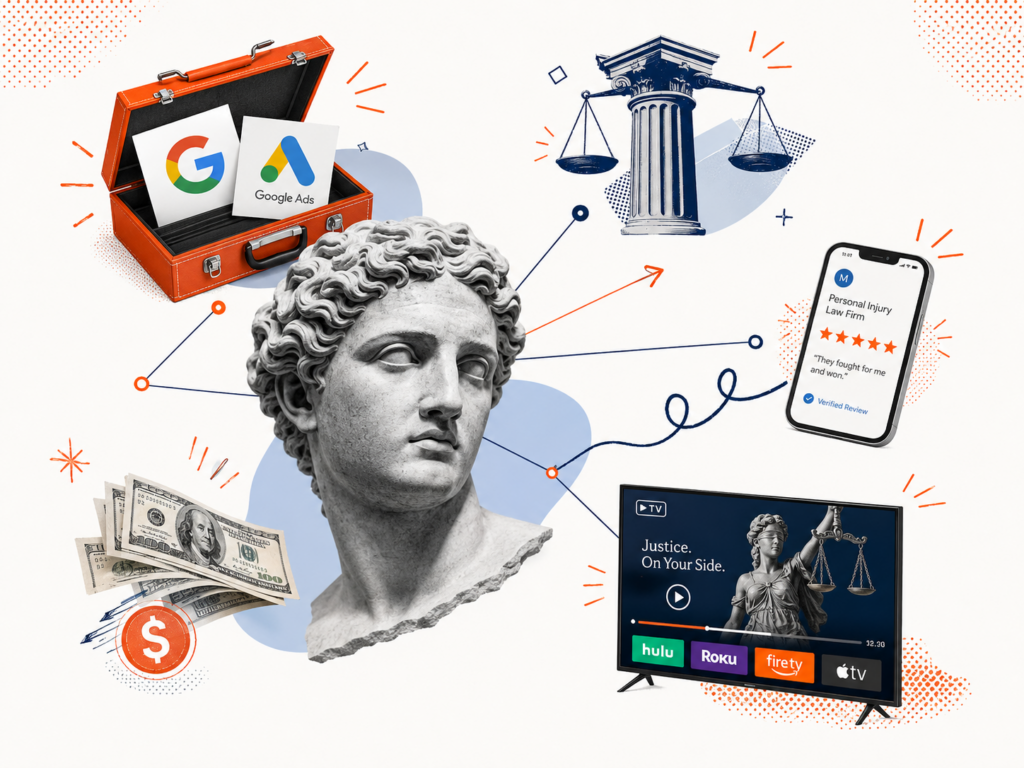
The Full-Service Advantage in Personal Injury Marketing
Many personal injury firms hire a digital-only agency for SEO and ads, a separate company for their website, a freelancer for video, and handle PR and events themselves. Every handoff between those vendors is a place where the brand drifts, the message splits, and the reporting falls apart.
A full-service partner runs strategy, brand, website, SEO, paid media, content, video under one roof, with one team accountable for one number: signed cases. That coordination is not a luxury. In a channel-by-channel fight against firms with deep pockets, having every piece pulling in the same direction is often the difference between growth and a plateau. We explain when this matters in our comparison of [full-service versus digital-only marketing agencies].
Frequently Asked Questions About Personal Injury Law Firm Marketing
How much does personal injury law firm marketing cost?
Most established personal injury firms invest 10 to 20 percent of gross revenue into marketing, though growth-stage firms often spend more. The right number depends on your market's competitiveness, your growth goals, and your current case volume. What matters more than the total is allocating it across SEO, paid media, and brand rather than putting everything into ads that stop working the moment you stop paying.
How long does it take to see results from personal injury marketing?
Paid channels like Google Ads and Local Services Ads can generate leads within days of launch. SEO and organic content typically take six to twelve months to produce meaningful ranking improvements in a competitive personal injury market. A sound strategy runs paid channels for immediate cases while building SEO and brand for lower-cost growth over time.
What is the most effective marketing channel for personal injury firms?
There is no single best channel; the firms that grow predictably combine several. Google Local Services Ads and the local map pack tend to deliver the highest-intent leads, organic SEO delivers the best long-term economics, and a strong brand lowers the cost of every other channel. The intake process that converts those leads into signed cases matters as much as any single channel.
Should a personal injury firm hire one agency or several specialists?
A single full-service partner generally outperforms a patchwork of specialists for personal injury firms because the channels reinforce each other and need to share one strategy and one message. When SEO, paid media, brand, and intake are managed by separate vendors, coordination breaks down and reporting becomes impossible to trust. One accountable team focused on signed cases is usually the better structure.
How do I know if my marketing is actually working?
Track cost per signed case by channel, not cost per lead or clicks. This requires call tracking that attributes every inquiry to its source, a case management system that records which leads sign, and reporting that connects marketing spend to actual fee revenue. If your current reporting only shows impressions, clicks, or leads, you cannot tell which channels are profitable.
Grow Your Personal Injury Firm With a Partner That Has Done It Before
CIM Marketing Partners has spent nearly thirty years building and growing law firm brands, including personal injury firms that became market leaders. We run strategy, brand, website, SEO, paid media, content, and intake support as one coordinated team, measured on signed cases. If you want a marketing partner who reports on revenue instead of vanity metrics, call 702.944.2464 or email info@cimmp.com to start the conversation.