For decades, personal injury firms had two options for television. Buy broadcast spots at rates set for mass reach, which meant paying to show your ad to millions of people who would never need a lawyer. Or skip television entirely and cede the medium to the firms that could afford it.
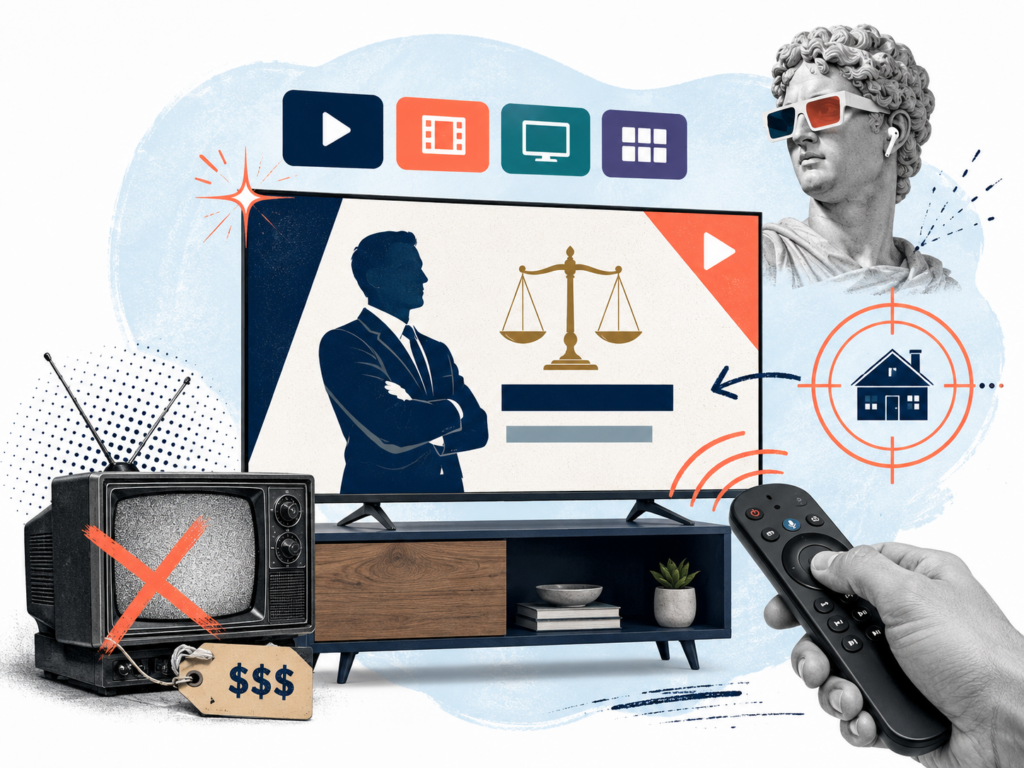
Connected TV and over-the-top streaming changed that math. Now, a firm can run a full television-quality spot on Hulu, Roku, Peacock, or Samsung TV Plus, targeted to a specific metro, a specific demographic, or even a specific household, at a fraction of what broadcast used to cost. For growing personal injury firms, OTT is one of the fastest ways to build brand recognition in a market without spending like the incumbent.
CIM Marketing Partners plans and runs OTT and connected TV campaigns for law firms as part of a coordinated media strategy. To talk about whether OTT belongs in your firm's mix, call 702.944.2464 or email info@cimmp.com.
What OTT and CTV Actually Mean
OTT stands for over-the-top and refers to any video content delivered over the internet without traditional cable or satellite. CTV, connected TV, refers to the physical devices that display it: smart TVs, Roku, Apple TV, Fire TV Sticks, gaming consoles. In practice the terms overlap and are often used interchangeably. The important thing is that these ads run on premium streaming inventory, in real television-viewing contexts, but with digital targeting and measurement.
From the viewer's perspective, an OTT ad looks and feels like a television commercial. It's 15, 30, or 60 seconds. It runs during a stream break. The viewer usually cannot skip it. From your firm's perspective, it's a targeted digital buy: You pick the metro, the demographic, the audience segments, and often the specific inventory. The result is the reach and impact of TV with the precision of digital.
Why OTT Works for Personal Injury Firms
Cost per Thousand That Broadcast Cannot Match
Broadcast television in a major metro can run $30 to $80 per thousand impressions for the kind of daypart a PI firm wants, with cable typically landing lower, often in the $15 to $30 range. Programmatic OTT usually runs $25 to $65 per thousand for premium streaming inventory, which on paper looks comparable to or even higher than broadcast. The real advantage isn't a lower sticker price. It's that OTT lets you target only the households likely to need a personal injury lawyer, so a much higher share of every dollar reaches someone who could actually become a client. A firm buying broadcast pays the same CPM whether the viewer is 8 or 80; a firm buying OTT can exclude most of that waste. That's the efficiency gap that matters, not the raw CPM.
Household-Level Targeting
OTT ad platforms can target down to household or even device level. That means a firm can serve ads only to households with a household income above a threshold, in specific ZIP Codes, and on devices whose viewing behavior suggests a certain age range. For personal injury, that lets you concentrate on the demographics most likely to need your services and skip the ones that won't.
The Halo Effect on Search
This is the underappreciated part. When a firm runs a consistent OTT campaign, its branded search volume goes up. People who saw the ad on Hulu last night search for the firm by name today. Google Ads clicks convert at higher rates because the searcher already recognizes the name. The map pack listing gets more clicks. Every downstream channel performs better. The direct response from OTT matters, but its bigger value is as a brand amplifier that lifts the return on every other channel.
What Good OTT Creative Looks Like for a Law Firm
A good OTT spot for a personal injury firm is not a discount pitch, and it is not a lawyer standing in front of a bookshelf reciting the firm name. The best-performing PI OTT spots share a few patterns.
They tell a specific story: an injured person, a moment of confusion, a call, a resolution. Real clients on camera, when possible and appropriate, out-convert paid actors by a wide margin. The message is confidence and specific competence: This firm handles injury cases, has done it many times, and will fight for you. The firm name appears clearly, and the phone number and website appear on screen long enough to be memorable, ideally with a simple tag that repeats across every spot so the market learns to recognize it.
Production quality matters. An OTT ad plays on a big television screen next to premium content, and viewers judge accordingly. A cheap-looking spot on Hulu next to a network drama undercuts the firm's brand instead of building it. This is where full-service capability separates results: the same team that plans the OTT buy should be involved in the creative, because the message, targeting, and brand have to work together.
Measurement: The Attribution Challenge
The hardest part of OTT for law firms is knowing what it did. Someone sees an ad on Roku, does not click anything (there is nothing to click), and calls the firm two days later. Whose credit is that? Attribution for OTT requires either a pixel-based measurement stack that tracks device IDs across a household, a unique phone number that runs only on OTT spots, or a lift study that compares intake in exposed markets versus control markets over time.
For most firms, the practical answer is a mix. Use a dedicated call tracking number in the OTT creative to capture direct-response calls. Watch branded search volume and organic Google traffic before, during, and after campaign flights. Monitor Google Ads cost per click and conversion rate to see if the halo effect appears. Any single metric is incomplete; the pattern across them tells the story.
When OTT Makes Sense (and When It Doesn't)
OTT belongs in a personal injury firm's mix when the firm has reached a size where brand starts to matter. That is usually a firm generating at least $2 to 5 million in annual revenue with an established market presence, considering aggressive growth. Below that threshold, most firms get better returns from concentrating spend on search, Local Services Ads, and local SEO.
OTT also assumes the rest of the marketing stack is already working. If your Google Ads are wasting spend on irrelevant queries, if your GBP is incomplete, if your intake team misses calls, adding OTT amplifies those problems rather than fixing them. Fix the leaks first, then use OTT to accelerate.
When it does fit, OTT often produces the strongest brand growth of any single channel and lifts the performance of every other channel above it. For firms competing against television-heavy incumbents, it is often the only way to close the brand gap without spending on broadcast.
Frequently Asked Questions About OTT for Law Firms
How much should a personal injury firm spend on OTT to see results?
Most firms need at least $10,000 to $25,000 per month in a defined metro to reach a meaningful share of the target audience with enough frequency to build recall. Below that level, the campaign either reaches too few people or reaches them too rarely to move brand recognition. Larger markets require larger investments to move the needle.
Can OTT ads be tracked to actual cases like Google Ads can?
OTT attribution is harder than search attribution because there is no click. Firms measure OTT through a combination of dedicated call tracking numbers, branded search lift, direct traffic increases, and formal lift studies comparing exposed and unexposed markets. Any single metric is partial; the pattern across all of them shows the impact.
Which streaming platforms are best for personal injury law firms?
Roku, Hulu, and connected TV inventory across programmatic platforms like The Trade Desk consistently produce the best reach and quality for personal injury firms. Peacock, Paramount Plus, and Samsung TV Plus add incremental reach in most markets. The right mix depends on the age and household demographics of your target market and the inventory available in your metro.
Should we hire an OTT specialist or a full-service agency?
Full-service tends to outperform siloed OTT specialists for law firms because OTT works best when coordinated with brand, creative, search, and local SEO. A specialist can run a technically strong buy, but a full-service partner can align the OTT message with the Google ad copy, the map pack listing, and the intake team's script, which is where the compounding returns show up. With an agency managing all aspects of a firm’s strategy, voice and messaging, coordinating all of this, the results are synergistic and measureable.
Add a Brand Channel That Lifts Every Other Channel
CIM Marketing Partners plans, produces, and runs OTT and connected TV campaigns for law firms as part of a coordinated media strategy that ties creative, targeting, and downstream conversion together. To explore whether OTT belongs in your firm's mix, call 702.944.2464 or email info@cimmp.com.