Behind the Scenes: The Process of Designing a Professional Logo

Have you ever wondered about the process of designing a logo? At CIM, the design process of creating a logo varies with every graphic designer. For some, it’s sketching concepts while listening to their favorite music. For others, it’s researching and exploring for creative ideas while sipping a strong espresso. Many steps are involved from concept to completion. Here’s a look behind the scenes…all the steps involved in creating a professional logo.

Step 1:

Creative Brief Discussion


The first step in designing a logo is to learn more about a business and its goals. Here are a few design information-gathering questions we always cover: What is the main purpose of the business? What is the brand’s personality or values? What are adjectives used to describe the brand? What kinds of customers or clients does the business have or want to attract? How do you want your customers to feel about the business? What are your preferences – font type, colors, fun versus formal? CIM aims to create a memorable visual representation for the business or service, so it’s critical to pull insights and information from each client.

Step 2:

Research the Industry


We research industry and competitor logos. This helps CIM designers get a sense of the environment the logo is going to live in and provides a framework for the next step of the process. Our designers ask themselves, "What colors, shapes, typography, graphic elements and taglines would make our client’s new logo powerful and effective?" They are especially cognizant of the psychology behind colors and shapes.

Step 3:

Start Sketching


After researching the industry, our designers at CIM will make rough sketches to explore any ideas that include logo, colors, typefaces and images. Sketching on paper is an effective brainstorming tool for designers to get the creative juices flowing and help see what elements work together or not.

Step 4:

Digitalizing the Design and Internal Review


Once the ideas are sketched, the best design concepts will be recreated in digital format using Illustrator. CIM designers will experiment with logo colors and typography to showcase the flat logo in variations that include mockups to see how it will work in real life. Then, the designer presents several strong logo options to a group of CIM team members for review and comment. Each logo’s concept is fully explained, and we share feedback to narrow the options.

Step 5:

Logo Presentation/Modifications


The refined logo options are presented and fully explained as to how and why they best represent the business or organization. Feedback is shared, and any desired edits (tweaking a color or graphic element, for example) are made until we have “the winner,” a solid logo that will withstand the test of time.
Step 6:

Final Logo Assets Delivery


Once the logo is finalized, CIM designers will organize and deliver the logo in multiple file formats that can be used for anything from marketing collateral to signage to the internet. We also provide a Brand Standards Guide that includes logo variations (like a black and white version) and color palettes so employees, partners and vendors can use the logo properly and consistently.

Since we believe brand is everything, a logo is certainly a core component. Creating a client’s perfect logo is a process, one that is critical to get right. We take pride in creating logos for brand new entities, and we also modify or update existing logos when that is appropriate. If you need any help with your brand/logo, we’d welcome a conversation.

"Logos are the graphic extension of the internal realities of a company."

~Saul Bass
(graphic designer and Oscar-winning filmmaker whose work includes timeless logos
for brands like Quaker Oats, Girl Scouts of America, United Way, AT&T and others)

Your Eggs + One Basket = A Very Bad Idea

This past Monday was a dark day for some of the largest social media platforms across the entire world. For more than 7 hours, Facebook, Instagram, and Whatsapp were completely down. While the details of what happened to the platforms are still a bit murky, what we do know is more than 2 billion people and more than 200 million businesses were unable to access the platforms, rendering their social media marketing efforts useless for the day.

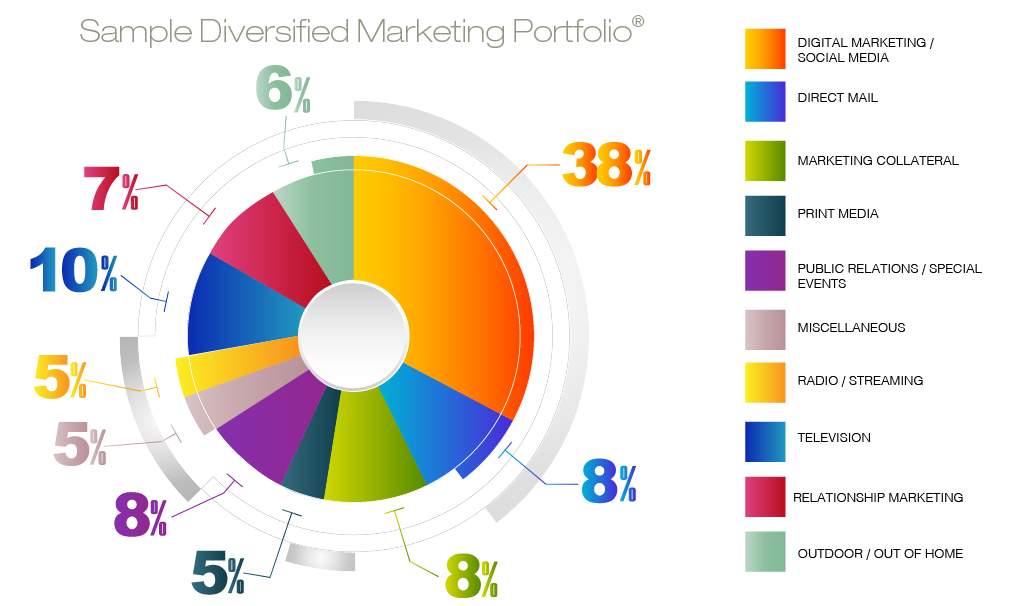
Social media is a critical part of a company’s marketing mix, and this week’s outage reminded us of the importance of having a diversified marketing approach. More than 20 years ago, we developed and trademarked our Diversified Marketing Portfolio®. After surveying a client’s business goals, its mix of products and/or services and the competitive landscape, we review dozens of potential tactics before allocating an annual budget across multiple strategic tactics to ensure a diversified approach.


To learn more about the Diversified Marketing Portfolio®, click the button below.

We’ve all heard not to put “all of your eggs in one basket,” so be sure your marketing efforts are diversified and balanced. If you need help, we’re here for you…this is what we have done since 1996.

“Social media is a great way to grow your business, especially if you are doing so on a low budget. However, it isn’t the only way to grow your business…”

~Kimberly Studdard

Taking Down Errant Reviews

In March of 2021, Google released a “Manage Your Reviews” tool, which gives Google My Business owners the ability to take down and see the status of each Google review on their page. This tool is convenient to help managers keep track of reviews that they have reported to Google for removal.

WHY IS THIS A GAME CHANGER?

There have been many fake, malicious, irrelevant or reviews posted to the wrong company on Google, resulting in a decrease in credibility and review ranking. The Manage Your Reviews tool, however, doesn’t work for business accounts with a large number of listings quite yet (like CIM who manages many Google My Business listings). This tool is ideal for small to medium businesses (SMBs). Although in its infancy and doesn’t work for everyone, this is a small step in the right direction of how Google manages review removal.

HOW DOES IT WORK?

You can find the Manage Your Reviews tool within the Google Help section. When you click on the tool, click on your business listing, which gives you the option to check the status of current review reports or to report a new review for takedown. When you click on “report a new review for takedown,” it will list all of the reviews in chronological order, with the option to report a problem on the right side of each review. You will then receive a shortlist of reasons why you wish to take down the review. After you click on the desired reason, the review will then be reported and you will additionally receive a follow-up email about the review.

MANAGE YOUR REVIEWS

If you would like to check the status of current review reports, you click on the status of current reviews button. A list of the reviews you reported will show in chronological order, and the status of each review will show on the right side, with it either saying the report has been approved and taken down, the decision is pending, or the report was reviewed and there was no policy violation. You have the ability to appeal a review if Google stated there was no policy violation and you believe there was. You then receive more in-depth options to state why you still wish to proceed with the removal of the review.

CONCLUSION

The “Manage Your Reviews” tool should ultimately work extremely well for businesses that receive fake or errantly posted reviews that either violate Google’s guidelines or are about a different company. The functionality of this tool to see the status of current review reports or report a review, although it only really works for SMBs that do not have a large number of listings.

STILL HAVE QUESTIONS ABOUT TAKING DOWN ERRANT REVIEWS?

CIM Marketing Partners is always here to help. We are more than happy to answer any questions you may have or help with the process of taking down errant reviews.

Customer service shouldn’t just be a department, it should be the entire company.

~Tony Hsieh, CEO Zappos

The 3 R's: Relationships, Referrals, and Reviews

I recently gave a presentation at Vista Consulting Team’s 2021 Annual Conference in Dallas. Vista is (obviously!) a consulting team that works with law firms across the country and Canada to improve their internal operations to maximize productivity and brand value, ultimately increasing performance and client satisfaction. To that end, I was invited to speak about strategic marketing tactics that lead to those outcomes. The presentation centered around relationships, referrals, and reviews, and how all three of these work together to build an established brand and build its new business pipeline. I’m happy to share with you some highlights of the presentation.

Relationships:

Relationship marketing can be defined as the ongoing process of identifying, establishing, maintaining, and enhancing successful relationships with clients/customers/stakeholders so that the objectives of all parties involved are met. This is done by mutual giving and fulfillment of promises.

Referrals:

CIMply put, a referral is an act of sending someone to another person or place for advice, assistance, or other help. Key point: Referrals come from relationships…they don’t come from automated responses, AI, or bots. They come from truly being engaged P2P (people to people). By establishing and building genuine relationships with clients, referral sources, and others in and out of your industry’s sphere, you can send and receive referrals to and from trusted sources.

Reviews:

A review is a narrative report card that addresses the quality of a company’s services and products so that newcomers can make an informed choice as to whether it's a good match for their needs. There are so many review platforms to monitor and manage (Google, Yelp, Avvo, Facebook, etc.), and your customers or clients will largely decide where to post a review about you. Just because you may wish that your company didn’t have Yelp reviews, won’t make it so. The point is, with statistics like those below, reviews are real, they make an impact on your business and its potential clients and they need to be managed (responding to both the good and bad).

Our best advice is to be proactive in your review management process. Designate someone within your company to monitor and reply to all posted reviews. We also suggest making it easy for your customers to give you a review, asking for reviews from satisfied customers, and repurposing great reviews on your website and social media. At CIM, we manage many clients’ review efforts (responding and soliciting) with services like BirdEye and Podium.

Embrace the 3 R’s and experience them working for you. If you’d like to discuss your approach or have the CIM team work with you to orchestrate your efforts, please let me know.

Nevada Business Awards

CIM was recently honored at Nevada Business Magazine’s Nevada Business Awards luncheon as a finalist in the “Others First: Philanthropy and Giving” category for DJs for PJs, the nonprofit organization it founded in 2001. DJs for PJs have collected more than 100,000 new pairs of PJs for children in need in Southern Nevada.

Create alliances: Everyone wins when you’ve got a network of quality referral partners.

~Unknown

Ready For 2021 Reboot!

What a year it has been. Summer’s gone. Cooler temps are finally here. Thanksgiving is around the corner, and December will be filled with holiday activities. That makes now the perfect time to prepare for and lock in an effective 2021 strategic marketing plan and budget.

What’s in it for you? By planning now, you’ll…

  • Avoid entering the new year with no plan, leaving you to only react to opportunities that may appear.
  • Get the whole team on board with where you’re headed, why you’re headed that way and how everyone can contribute to getting there.
  • Save marketing dollars by working with your marketing/PR agency to identify and evaluate the best opportunities (those with the greatest ROI), as well as potentially lock in lower 2020 media rates into 2021.

Investing in planning now will allow you to more fully enjoy the remainder of this year and help ensure a more profitable, more focused, and less stressful 2021. After reading the next few sentences, switch screens on your computer to see your calendar. Block off several hours with others involved in your marketing decision-making process and plan for a review of your business and the competitive landscape.

Now is the time to take the time to work through important questions and begin to develop your strategy for 2021 marketing:


We suggest you work through this “reflection and review” as a starting point to nail down a true strategic approach for 2021. If you need help, ask for it! Working with a team like CIM Marketing Partners can put you on a more solid path to growth and prosperity, while at the same time freeing YOU up to focus on what YOU do best (like operationalizing your company’s products and services, and providing superior client service and experiences).

With your plan in place (and the ability to adjust it as needed in our current environment), you’ll experience marketing efforts working behind the scenes to improve profitability and ultimately build the value of your company.


Quote of the week:

Planning is bringing the future into the present so that you can do something about it now.

Alan Lakein


Managing Your Brand: Design 101

It’s all around us: Bad graphic design. Whether on a billboard, on a website, or in your mailbox, you know it when you see it. One of my team members even keeps a “Marketing Mishaps” folder filled with examples from over the years, just for fun. Thankfully, there are some rules of thumb to help you avoid design blunders and properly manage your brand. Here are a few:

Trust a talented designer. You’ve invested a lot in your brand, the visual part of it. Your logo, tagline, branding elements, colors, and brand standards/usage guidelines are the foundation pieces. With those in place, it’s up to a pro to know how to use them as a part of extending your brand, creating your brand presence effectively. A designer gets to understand your brand and knows how to artfully balance design and verbiage to propel your message.

Less is more. The recipient will remember your message when you communicate it CIMply and clearly. You don't have to display all brand elements in every instance just because you have them.

While you may have built a treehouse in the backyard, you wouldn’t try to build your new home yourself. True designers have innate talent and training to use tools to pull it all together.

Stand out. When looking head to head at competing products and services, you want to best the competition’s offerings. How you do this is by having well-conceived, graphically pleasing designs that reach this goal. A designer knows how to accomplish this for you.

Don’t forget the family. Your brand family, that is. Your brand footprint is ever-expanded by using your brand elements everywhere you have a presence. Your printed marketing materials should match your digital marketing efforts. Whether one visits your website, views your social media pages, or receives an email or actual mailpiece from your company, it should look and feel like it’s something about your company.

Brand consistency doesn’t happen by itself, but must be managed, and that ultimately helps lead to a higher trust in a brand: “I know this company, I recognize this company, I like doing business with this company.” Think about Apple, for example. When this company touches you with a message, do you almost instantly know it’s Apple?

Investing in good design pays for itself in spades through building your competitive advantage, elevating your company’s products and services above others, increasing actual sales and revenue and, ultimately, driving marketing results. Step one: Make sure it’s being effectively led and managed by someone or a team you trust.

Happy Labor Day!

Quote of the week:

…knowing how to use a design or art software doesn’t make you a designer.

Adri M.

Watch Now vs. Read More

For years, we’ve been encouraging and helping our clients to incorporate video content into their marketing mix – website, email marketing, social media platforms, and online advertising. Research continues to show an increase in the number of people who, given the option of watching a video or reading information, choose video. A few statistics:

In addition to well-written content, video is another touchpoint with significant benefits. Videos are natural attention grabbers. Their movement draws people in to watch and learn more. Search engines love video and typically return search results of video higher within the rankings, making your website (and its videos) more likely to be discovered.

What types of videos might you consider creating?

Talking heads or interviews:

These videos can be a person simply talking about your company, a service or practice area, or two people discussing a particular topic. The content should ultimately focus on the viewers, that is, offering to help them with something they need, or providing a solution or answers.

Explainers or “doodle”:

These animated or sketch videos literally draw a picture while telling a story, describing how something works or walking the viewer through a process. Keywords typically appear within the video, which is narrated throughout.

Testimonials

Testimonials:

These videos feature actual customers or clients talking about their experiences in working with your company.

Demonstrations:

These videos feature the use of a product or “how-to” to illustrate how something is done or used. These are along the lines of explainer videos, but used when providing a detailed walkthrough on using a product or navigating a process.

The most impactful videos are engaging, entertaining and informative. While a mix of video lengths is appropriate (longer for certain purposes), with the shorter attention span of many people today, short videos (under 90 seconds) have a higher chance of being viewed to the end. Even shorter videos (under 15 seconds) may be required for online advertising to very quickly make a point and encourage a click-thru to your website to learn more.

If your marketing efforts don’t include video, it’s a missed opportunity to connect with your target audiences, to let them hear and see what you do and how you help clients. If you would like to discuss how video can be effectively created and incorporated into your marketing efforts, please reach out.


Quote of the week:

Business decision makers LOVE online video because it gives them the most amount of information in the shortest amount of time.

Robert Weiss, Use YouTube Video Marketing to Generate Leads, Awareness and Customers


Getting Social With It

Are you feeling overwhelmed by social media? For businesses, over the past few years, it has become a necessity to establish and maintain a presence on various social media platforms. Especially now, in a time where an in-person conversation is not always possible, many have turned to social media as a way to communicate directly with their audience. Some companies have reluctantly been forced into social media, simply because this is where people are these days. Others have embraced these new communication channels as additional avenues to build awareness and attract clients. Here are a few “lessons learned” from our team, who is immersed in the social media landscape. They have become guiding principles to avoid becoming overwhelmed, allowing us to focus resources most effectively.

CHOOSE WISELY:

For the past few years, my social media team and I have attended Social Media Marketing World, one of the largest social media conferences in the country. From them, we learned that you fail at social media by trying to be active everywhere and not giving any of them your all. Instead, you should pick one or two and be REMARKABLE on those platforms. Choose the ones that make sense for your company. Where are your current and potential clients interacting? What are their demographics? Match your efforts to your audiences.

MAINTAIN ACTIVITY:

If you’re going to have a presence on a particular platform, do so with intent. Beyond building out your landing page to reflect (graphically and content) your brand, plan regular new content and posts, and stick with it. Avoid the bad impression that results from a client or prospect seeing that you haven’t had any activity in the recent past. Build out a content calendar for posts and react/reply to posts of others on your pages.

PROVIDE VALUE:

Visitors to your pages should experience content that resonates. There should be a good mix of posts: Consider product/service updates, testimonials, team member profiles, client stories, and special events. Each post should connect in some way with visitors, making them feel a part of your company. Your presence on social media platforms is an opportunity to further enhance and manage your overall brand and its reputation. Planning and managing your efforts will help you avoid feeling overwhelmed and overworked.


Quote of the week:

We don't have a choice on whether we do social media, the question is how well we do it.

Erik Qualman


Look Good + Sound Great = Success!

YOU’RE LOOKING GOOD, OR AT LEAST YOU SHOULD BE

Just as most people like to present themselves in a good light, positioning your brand to make a positive impression takes work. In fact, the way your business presents itself plays a key role in how you’re received by your target audience. An overall aesthetic that’s sharp, eye-catching, modern, and memorable will help promote your brand and ensure your business is top of mind when it needs to be. That must be accompanied by great content. Beyond your website, here are three (out of many) areas to review and potentially upgrade:

YOUR LOGO/BRAND MARK

Your logo is a visual representation of your brand. A clean, sharp logo will set you apart, help tell your brand’s story and become ingrained in the minds of your intended audience. Your brand’s logo should be unique and play well with all media. It should make a statement and let your audience know about your business. Think about the Nike Swoosh. It’s memorable, it creates interest, and it has become synonymous with the brand and the company name.

A great logo is versatile; it should look just as sharp on your business card as it does on a highway billboard. If your logo doesn’t convey the “brand promise” it should, or if it’s simply time for an update, make that a priority, as your logo/brand mark is truly the foundation piece for so many marketing components.

YOUR MARKETING COLLATERAL

We hear it often: Do we need printed marketing materials? Our answer: YES! Every business has a need for sales materials. Most of the pieces we create for clients end up as PDF files being used as email attachments and for downloads from a website, as well as commercially printed copies for hard-copy mail-outs and use at events and in-person meetings where a tangible leave-behind still has value. Fewer hard copies (as compared to years past) need to be printed, but when a “wow” marketing piece is needed to make that first impression, you’ll have it.

All marketing pieces should be fully branded with your company’s colors, logo and brand marks. Regarding content, the verbiage should be friendly, informative and “speak” to the reader, focused on WIIFM, “What’s In It For Me?” Sure, the piece will contain background information about your company and its products/services, but it’s also critical to provide details about what you do to help companies, how you solve their pain points and how you provide immeasurable value to those you work with.

YOUR SOCIAL MEDIA FLAIR

While written content is incredibly important for your social media marketing strategy, we also believe the visual elements are equally as critical. A link to a well-written blog post may go unclicked if the accompanying visual graphic is uninteresting. An article may go ignored, where a video may capture the intended audience. A crisp and original animated graphic may stop the scrolling thumb in its tracks. An informative data visualization or infographic may provide jaw-dropping statistics in an easy-to-digest visual format.

The visual assets on social media help catch your audience’s attention. Draw them in with the design and then hook them with your exceptional written content! Make sure your written message lines up well with your visual message, to ensure everything is clear and concise. Whether you want to close the deal on a social media platform or funnel your prospects to your website, the visual design elements can be wildly effective bait.

Brand positioning has so many facets, including graphics, colors and branding elements that help paint the picture of your company and what your team does. If you would like to discuss strengthening your brand, let’s talk. Our team takes pride in doing that every day.


Quote of the week:

Your brand is the single most important investment you can make in your business.

Steve Forbes


The Power of Memorable Moments

It was quite a memorable moment when I finished reading a great book, The Power of Moments. What an impact can be made with some simple, implementable tips. Here’s a summary that I hope will inspire you to create memorable moments for your customers, employees, and clients.

What’s a Defining Moment?

CIM Surprise

Start by thinking about and recognizing some memorable moments in your life. Surely, you have some standouts in your personal and professional interactions. How has a business delighted you? How did someone please or surprise you?

Now, look at your interactions with your team and those you serve. Brainstorm to create touchpoints to wow both. Remember, in marketing, meaningful moments matter; don’t miss a huge opportunity by leaving them to chance.

If you would like to discuss how we could help you create meaningful moments for clients, please reach out.


The Power of Moments
by Chip Heath and Dan Heath

Quote of the week:

The best things in life aren’t things. They are moments.

Unknown