Don’t Underestimate the Power of Print

With inboxes overflowing and digital ads everywhere, print marketing offers something unique – tangible, lasting impact.

A well-placed, strategic print campaign can reinforce your digital efforts and drive real results.

The Future of Analytics is Here

Embrace Google Analytics 4 for Enhanced Insights

The countdown is on! Google has announced the sunsetting of Universal Analytics on July 1, 2023. If you haven’t set up, or if you haven't asked your webmaster to set up and install Google Analytics 4 (GA4) on your website, you only have a little bit of time to get it done. (Note: If CIM is your webmaster, rest assured we have been utilizing GA4 since its announcement running parallel to Universal Analytics on your site.)

While Google lists numerous reasons for the change, the biggest one is to comply with increasing regulations and laws regarding online user privacy. GA4’s enhanced data privacy features align with evolving regulations and user expectations. With GA4, businesses and marketers can easily configure data collection settings, ensuring compliance with privacy laws while maintaining accurate tracking. This helps foster trust among users and strengthens data governance practices.

This property will stop processing data starting July 1, 2023.

This property will stop processing data starting July 1, 2023.

GA4 can bring numerous benefits to businesses of all sizes. With its advanced features and improved tracking capabilities, GA4 offers valuable insights that can drive data-informed decision-making and enhance overall marketing strategies.

1A major advantage of GA4 is its ability to provide a comprehensive view of user behavior across multiple devices and platforms. Traditional Google Analytics focused primarily on website data, but GA4 incorporates data from websites, apps, and other digital touchpoints, including social media platforms, email marketing, live chat, chatbots and voice assistants. This holistic approach enables businesses and marketers to understand the complete customer journey and make informed decisions to optimize user experience.

2GA4 has enhanced event tracking capabilities. Unlike its predecessor, GA4 places greater emphasis on event-based data collection, allowing businesses and marketers to track specific user actions, such as button clicks, form submissions, purchases, and video plays. This granular data empowers marketers to analyze user engagement and identify opportunities for improving conversion rates and user retention.

3GA4 introduces machine learning models that provide valuable insights without requiring complex configurations. The AI-powered insights feature in GA4 can automatically identify trends, anomalies, and opportunities within the data, saving time and effort for marketers. These insights can uncover valuable information about user preferences, allowing businesses to optimize their marketing efforts and tailor their campaigns to specific target audiences.

4GA4 offers a streamlined reporting interface that presents data in a more intuitive and user-friendly manner. The updated interface allows for easier customization of reports, making it simpler to extract the desired insights. The improved data visualization options and built-in data exploration tools further facilitate data analysis and interpretation. The one shortcoming is its reporting. The ability to easily print or create PDFs of its dashboard is limited. A third party platform like Looker Studio is recommended in order to format the data in an easy to digest format.

5GA4 allows businesses to future-proof their analytics setup. Google continues to invest in GA4 as its standard analytics platform by making it scalable, flexible, compatible with evolving standards, advancing machine learning, and data governance and security.

The benefits of switching to GA4 are clear. Its comprehensive view of user behavior, enhanced event tracking capabilities, AI-powered insights, data privacy features, streamlined reporting interface, and future-proofing potential make it a valuable tool for businesses and marketers seeking to leverage data for informed decision-making and marketing success.

The above information offers a glimpse of the depth of details and ever-changing digital landscape our team lives in each day. If you’d like to discuss assistance with your marketing needs, please reach out to me at dneighbors@cimmp.com or 702.944.2464. Thank you.

Simplify Event Planning with Our Innovative Event Management Solutions

Anyone who is in charge of putting together even a small event quickly learns the task is much more substantial than one might think. There is a lot to consider, and dozens upon dozens of details to be thought through and planned.

Since our founding more than 26 years ago, we have conceived and planned hundreds of events for our clients, ranging from open houses to full-blown national conferences with hundreds of attendees. We are proud to have pulled off brand building, successful events that have been meaningful to attendees and the clients themselves.

Now, we’ve opened up our event planning and management services to anyone.

Please visit our new event services landing page on our website to learn more about how we approach planning an event and examples of all the facets of making the event a complete success.

If you’re considering an event of any kind, our expert event management team can help you unlock the full potential of that event. If you have any questions or would like to learn more, please reach out to me.

“To create something exceptional, your mindset must be relentlessly focused on the smallest detail.”

~Giorgio Armani

The Silver Lining of Rising Printing Costs

For more than a year, we (and our clients) have been experiencing rising costs for virtually everything we print for our clients. We’re not talking about periodic “slight price increases.” Commercial printing costs have been rising due to a number of factors, including basic supply and demand, paper pulp and end product shortages, shipping expenses, staffing issues and paper mill closures. But there’s some good news in the mix…read on.

It all began with the COVID shutdown, which sharply reduced use of certain paper types. With most schools and offices closed, paper use plummeted, and many factories suspended or reduced operations. Some factories reduced the production of printing paper to producing boxes as consumer demand shifted. This caused a ripple effect in raw materials used to make printing paper, and then worldwide shipping chaos added to the problem. And let’s face it, we all know what happened (and is happening again) with toilet paper and paper towel supplies. With the economic re-start, the supply chain ripples continue. Here are a few facts:

 
Paper pulp prices are up 20% over the past year.
The producer price index has risen more than 13% since December 2020.
Worldwide shipping backlogs are expected to last well into 2022, or longer.

The good news is that due to these issues, some are postponing their commercial printing orders. If your competitors are cutting these marketing efforts, the tactics you continue to implement will stand out all the more. We’ve proven over the course of decades that companies that continue to invest during rough economies come out far ahead of competitors that ceased or reduced their marketing efforts.

At CIM, we are doing all in our power to minimize commercial printing issues for our clients:

This is a global issue, adding to the complexity of normalizing “the system.” Meanwhile, we’ll continue adjusting as needed and, in some cases, incorporate digital tactical options, where appropriate. Please let me know if you have any questions.

“Now supplies of certain [paper] grades are so tight that some commercial printers can’t get the paper they want at any price.”

~Kevin Mason, managing director for ERA Forest Products Research

Your Eggs + One Basket = A Very Bad Idea

This past Monday was a dark day for some of the largest social media platforms across the entire world. For more than 7 hours, Facebook, Instagram, and Whatsapp were completely down. While the details of what happened to the platforms are still a bit murky, what we do know is more than 2 billion people and more than 200 million businesses were unable to access the platforms, rendering their social media marketing efforts useless for the day.

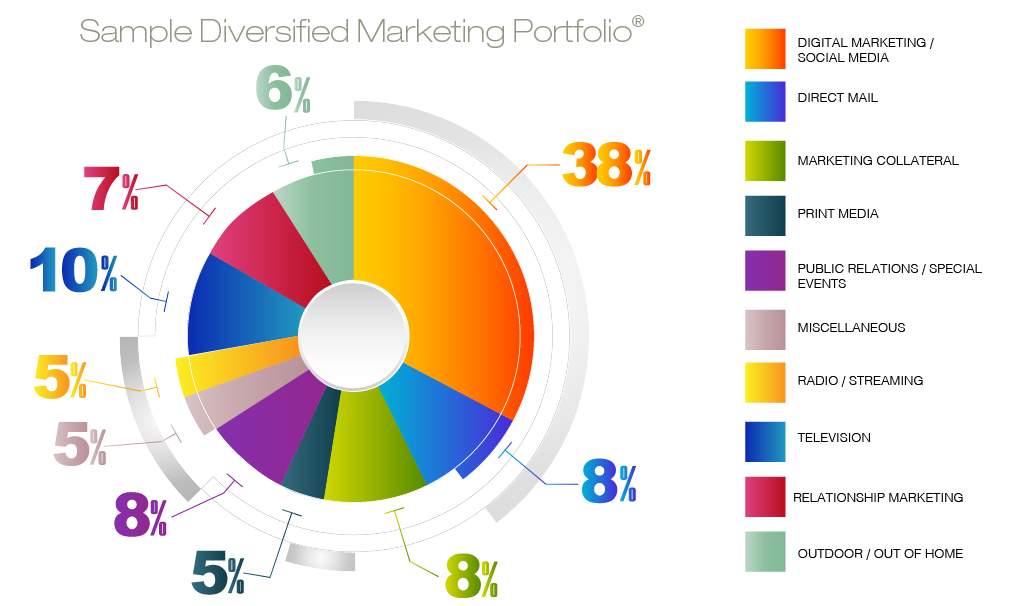
Social media is a critical part of a company’s marketing mix, and this week’s outage reminded us of the importance of having a diversified marketing approach. More than 20 years ago, we developed and trademarked our Diversified Marketing Portfolio®. After surveying a client’s business goals, its mix of products and/or services and the competitive landscape, we review dozens of potential tactics before allocating an annual budget across multiple strategic tactics to ensure a diversified approach.


To learn more about the Diversified Marketing Portfolio®, click the button below.

We’ve all heard not to put “all of your eggs in one basket,” so be sure your marketing efforts are diversified and balanced. If you need help, we’re here for you…this is what we have done since 1996.

“Social media is a great way to grow your business, especially if you are doing so on a low budget. However, it isn’t the only way to grow your business…”

~Kimberly Studdard

Taking Down Errant Reviews

In March of 2021, Google released a “Manage Your Reviews” tool, which gives Google My Business owners the ability to take down and see the status of each Google review on their page. This tool is convenient to help managers keep track of reviews that they have reported to Google for removal.

WHY IS THIS A GAME CHANGER?

There have been many fake, malicious, irrelevant or reviews posted to the wrong company on Google, resulting in a decrease in credibility and review ranking. The Manage Your Reviews tool, however, doesn’t work for business accounts with a large number of listings quite yet (like CIM who manages many Google My Business listings). This tool is ideal for small to medium businesses (SMBs). Although in its infancy and doesn’t work for everyone, this is a small step in the right direction of how Google manages review removal.

HOW DOES IT WORK?

You can find the Manage Your Reviews tool within the Google Help section. When you click on the tool, click on your business listing, which gives you the option to check the status of current review reports or to report a new review for takedown. When you click on “report a new review for takedown,” it will list all of the reviews in chronological order, with the option to report a problem on the right side of each review. You will then receive a shortlist of reasons why you wish to take down the review. After you click on the desired reason, the review will then be reported and you will additionally receive a follow-up email about the review.

MANAGE YOUR REVIEWS

If you would like to check the status of current review reports, you click on the status of current reviews button. A list of the reviews you reported will show in chronological order, and the status of each review will show on the right side, with it either saying the report has been approved and taken down, the decision is pending, or the report was reviewed and there was no policy violation. You have the ability to appeal a review if Google stated there was no policy violation and you believe there was. You then receive more in-depth options to state why you still wish to proceed with the removal of the review.

CONCLUSION

The “Manage Your Reviews” tool should ultimately work extremely well for businesses that receive fake or errantly posted reviews that either violate Google’s guidelines or are about a different company. The functionality of this tool to see the status of current review reports or report a review, although it only really works for SMBs that do not have a large number of listings.

STILL HAVE QUESTIONS ABOUT TAKING DOWN ERRANT REVIEWS?

CIM Marketing Partners is always here to help. We are more than happy to answer any questions you may have or help with the process of taking down errant reviews.

Customer service shouldn’t just be a department, it should be the entire company.

~Tony Hsieh, CEO Zappos

Marketing in Difficult Times - Double Down

Since the beginning of the pandemic, I’ve touched a time or two on marketing philosophies. One of those is that even the darkest of times, it’s helpful to find a bright spot...either find one, or create one. 

You and your team are surely already over-performing on many fronts, maintaining your accounts, and striving to perform for and keep existing clients, as well as fill your new business pipeline. As importantly, you’re making adjustments to your products and services and how you deliver them. At the same time, you’re working hard to reassure and thank your team for all of their efforts. 

As a partner in marketing for many clients, we are doing the same, and I’d like to share some of what we know to be true and effective in that realm.

As you march forward through the times we’re in, seek the bright spots for your business, your team members, and your long-term success. Let what you do today, in part, create your tomorrow. 


Quote of the week:

Businesses that maintained or increased their ad spend during the recession averaged higher sales growth both during the recession and in the following three years.

Professor Andrew J. Razeghi
(at the Kellogg School of Management, citing a McGraw-Hill Research study of over 600 businesses)

Chaos Resets the Playing Field


We’ve all been experiencing a world of chaos over the past few months, and in a recent peer group, we discussed how chaos resets the playing field. It reminded me of a tool we use at CIM to work through problems and frustrations, whether at home and/or work. Wouldn’t it be nice to take control and bring back some stability? It’s time for a reset.

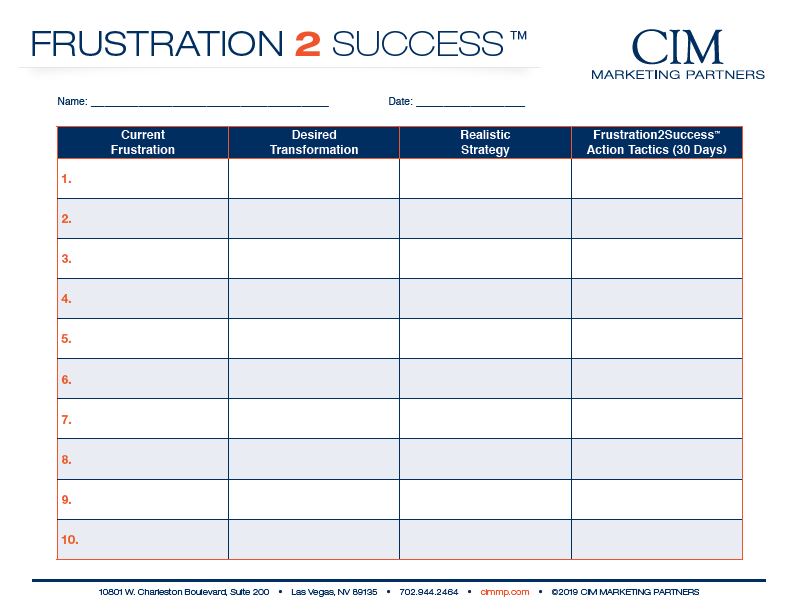
When we aim to solve a problem, it’s most effective to first well-define the problem so we can start to outline a path to solving it. We created a tool, Frustration 2 Success, to help identify and work through frustrations you may be experiencing. As you’ll see, it’s pretty straightforward... and that simplicity can help you more easily take charge of resolving problems and minimizing frustrations you experience.

Frustration 2 Success
Click image to download worksheet

Here are a few tips as you sit down with the worksheet:

In a leadership program I’ve been involved with for nearly two decades, one quote I’ve never forgotten is Progress, Not Perfection. Taking action steps to improve our lives makes a huge difference in the long term. I hope this worksheet inspires you to take charge in ways that are helpful and meaningful to you.


Quote of the week:

To conquer frustration, one must remain intensely focused on the outcome, not the obstacles.

T.F. Hodge


Communicating with Compassion


As you navigate the way through the new reality of COVID-19, you’re balancing so much: Taking care of your family and yourself, managing your company and team, reworking your business plan and continuing to serve your clients. IF you are able to safely continue servicing your clients given the current situation, communicating that is especially critical.

Focusing on your current clients is key, providing them with the services and resources you’ve always provided and supporting them in new ways. As we’ve always heard, it’s much easier and more financially beneficial to keep current clients by performing admirably than by focusing on new client acquisition. Top questions for your leadership team to ask:

Communication is critical. Let your clients know your company and its team are still available, offering the services they continue to need. Your service delivery methods may have changed; let them know how you’re meeting their needs (Video conferencing? Electronic document signatures?). Communication must be regular and consistent, at least once per week. Reassure your clients that you’re here and working to support them as you always have.

Bottom line: Your company and team are fully available to provide them with the services and value they have come to expect and to be a compassionate community partner.

If you need assistance in crafting messages for your internal team, clients, patients, etc. – as we have already done for many clients – please reach out and we will make it happen!

What a time the last few weeks have been for all of us. I truly hope your family, you and your business are all doing as well as possible. Please prioritize taking care mentally and physically.


Quote of the week:

Optimism is a strategy for making a better future, because unless you believe that the future can be better, you are unlikely to step up and take responsibility for making it so.

Noam Chomsky

PPC vs. SEO: Head to Head

In today's world, you have undoubtedly heard of SEO and PPC. The terms are unavoidable in our digitally, Internet-focused world. Everywhere you turn, there's a new article detailing new SEO strategies and exploring how PPC will enhance your overall web strategy. We won't lie: it can be confusing. Step one to successfully using SEO and PPC in your marketing efforts is to understand the similarities and differences between the two.

There are strategic reasons to utilize PPC and SEO practices. Both PPC and SEO are part of SEM (search engine marketing), which is one of the tools used for online advertising. Although different methodologies, each of their goals is to generate more traffic and ultimately lead to an increase in conversions (phone call, form submission, etc.).

First, let's look at each of their definitions. PPC, meaning Pay Per Click, is a form of advertising that involves bidding on targeted keywords through an ad platform in order for your ad to show up at the top of the search engine results page. SEO, meaning Search Engine Optimization, is optimizing your website in order to make it more relevant to natural or organic search terms.

Now, let’s examine the benefits to each practice. PPC can yield instant results and connects you with people who are looking for what you are offering. PPC offers targeting to reach specific groups of people, perhaps with specific interests and/or in geographical areas -- ultimately a demographic that may be more likely to purchase. Finally, PPC guarantees a steady stream of visitors and allows you to promote a specific deal, product or service. Alternatively, SEO has multiple benefits. For example, SEO’s return on investment will continue to rise over time and is, therefore, better in the long run. SEO relies on organic searches which consumers tend to trust more than sponsored advertisements. In addition, SEO helps your website show up more often in relevant organic searches.

Knowing the benefits to both PPC and SEO, it is also important to understand the limitations to each. For example, PPC does not improve organic search rankings. PPC requires testing campaign variables to improve conversions and overall ROI. In addition, PPC requires continual monitoring to optimize performance. Some of the limitations to SEO are that it requires more time in order to generate results. SEO also requires ongoing upkeep, and a lot of factors are simply out of your control. Finally, SEO requires dedicated time to monitor through various tools and make content adjustments or add additional content.

The decision to utilize PPC or SEO is contingent on your business’ goals and which practice makes the most sense to fulfill those goals. In an ideal world, the use of both marketing practices would be beneficial for accomplishing short- and long-term goals. However, each practice on its own offers respective costs and benefits for a business’ search marketing capabilities.