Chaos Resets the Playing Field


We’ve all been experiencing a world of chaos over the past few months, and in a recent peer group, we discussed how chaos resets the playing field. It reminded me of a tool we use at CIM to work through problems and frustrations, whether at home and/or work. Wouldn’t it be nice to take control and bring back some stability? It’s time for a reset.

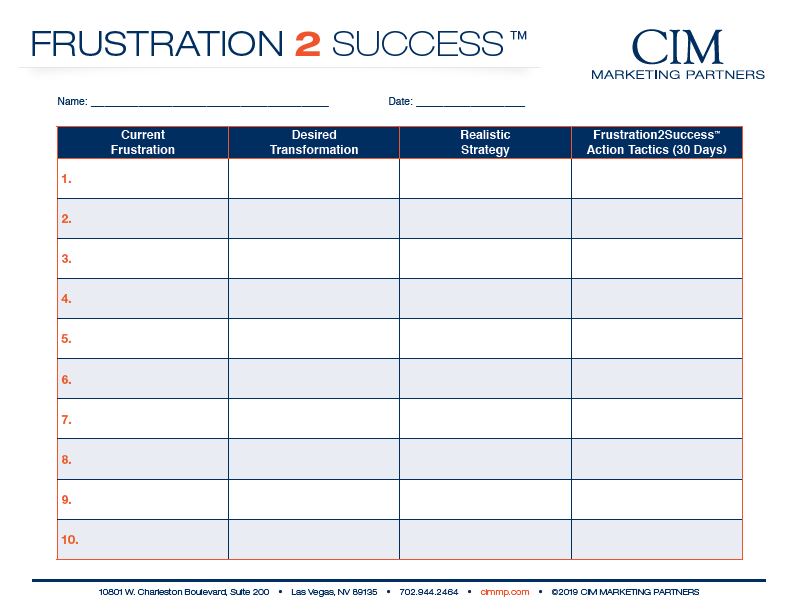
When we aim to solve a problem, it’s most effective to first well-define the problem so we can start to outline a path to solving it. We created a tool, Frustration 2 Success, to help identify and work through frustrations you may be experiencing. As you’ll see, it’s pretty straightforward... and that simplicity can help you more easily take charge of resolving problems and minimizing frustrations you experience.

Frustration 2 Success
Click image to download worksheet

Here are a few tips as you sit down with the worksheet:

In a leadership program I’ve been involved with for nearly two decades, one quote I’ve never forgotten is Progress, Not Perfection. Taking action steps to improve our lives makes a huge difference in the long term. I hope this worksheet inspires you to take charge in ways that are helpful and meaningful to you.


Quote of the week:

To conquer frustration, one must remain intensely focused on the outcome, not the obstacles.

T.F. Hodge


Defining Moments...

Nowadays, your life may seem like a blur. Our world has been turned upside down...at work and at home. I hope you’re doing all you can to stay safe, balancing your work and home life as best as possible.

In the midst of it all, there are defining moments, and you have the power to actively choose to make them. Some examples:

Recognize:


Pivot:


Plan:


I thank everyone who has contacted me over the past weeks. They’ve shared challenges, success stories, insights into our situation, and inspiration. I hope you’re staying connected with those who matter the most.


Quote of the week:

"Once you become fearless, life becomes limitless."

~Unknown

The Reality of Now and Later

We at CIM Marketing Partners hope this message reaches you doing as well as you can in our current challenge. Please continue to do all you can to keep your team, your family and yourself healthy and safe.

As you know and are likely experiencing yourself, businesses are scrambling to maintain operations and client services. As you’re busy doing just that, there are certain things you and your team can focus on now to ensure your business comes out as strong as possible once COVID-19 isn’t ruling our lives. Some of these are based on some reading I’ve been doing that looked at how certain companies fared better than others during our 2008-2009 economic downturn. We also saw a similar correlation with our own clients’ activities during that downturn.

You may find some strength and inspiration in the following fact about 2008-2009: Companies that responded to the downturn only by cutting costs lost ground after the Great Recession. Companies that prove valuable to their clients and met their needs aggressively recovered faster and stronger.

Do what you can do, and more! Focus like a laser beam on what your clients need and rally your team to deliver like never before.

What you are doing now is already playing a role in your business’ outcome after COVID-19.

Stay healthy and safe, stay strong and please reach out if the CIM team can help you in any way.


Quote of the week:

Trust the wait. Embrace the uncertainty. Enjoy the beauty of becoming. When nothing is certain, anything is possible.

Mandy Hale

The Benefit of Company Culture

Company culture distinguishes the values, goals, and attitudes of the employees that make up a company. When individual and company-wide values align, workers feel more appreciated and valued for the work they do in furthering company objectives. Productivity, profitability, and professionalism trend upwards when company culture is strong and healthy, as their image of success shines amongst competitors, creating a competitive advantage. Company culture has a snowball effect on the health and well-being of a company. As company culture improves, the productivity of happy employees increases, which then increases the financial health and overall profit of the company. A company’s productivity measures the effectiveness and efficiency of employees within the company, directly correlating to the success and completion of their objectives punctually.

As times change and technology advances, millennials are brought into companies to keep up with the everchanging and updated technology incorporated in company operations. Millennials are the driving force powering the future of the workplace. The discussion of strong, compelling culture within a company can either attract or deter the millennial audience. In this day and age, millennials want to feel like their work matters, like the time they spent accomplishing even the most mundane tasks are furthering the greater good in the world surrounding them. A strong company culture allows them to better recognize the values and goals of the company, drawing the connections to the outward impact it carries into society.

“There’s no magic formula for great company culture. The key is just to treat your staff how you would like to be treated.”
- Richard Branson

The importance of company culture resounds in a business’ success. Company culture weighs tremendously on the productivity, profitability, and professionalism of employees and the company as an ensemble. If the culture is unhealthy or lagging, employees prioritize duties that will meet their own needs, such as moving up the corporate ladder or improving their salary and benefits. This is due to the fact that the workforce does not feel like they or their efforts are valued by management. Appreciating and valuing employee efforts, no matter how big or small they are, in a client project can contribute to the establishment of healthy company culture practices. By focusing efforts on culture, you are establishing a differentiating factor from competitors who foster poor or nonexistent company culture as they focus too much on the success of the business as a whole, not leaving time to motivate or admire the efforts of those within the company. Creating a foundation of positive company culture, one in which employee engagement organically promotes productivity, can make or break the success of your company.

There are many well-known companies who excel in promotion of their company culture. Zappos has become almost as reputable for their company culture as it is for product and customer service. Ten key core values are instilled in each employee as they are hired and trained. Amidst the fast-moving operations of their business, Zappos takes time to budget and plan specifically for team building as well as internal culture promotion. This is done to encourage their employee and assure them of the impact their efforts make on the success of the company. Another well-known example is Google. Not only do they offer employees a fun working environment and substantial benefits to being a part of their team, they prioritize a strong culture of leadership and mentorship to help their employees succeed. By creating a workspace where people can and want to grow, they attract some of the best talent in the industry and express the worth of their efforts. In terms of strong company culture, both Zappos and Google have taken the initiative to hire people with company culture fit in mind.

How will you shift your focus to promote a healthy company culture?

PPC vs. SEO: Head to Head

In today's world, you have undoubtedly heard of SEO and PPC. The terms are unavoidable in our digitally, Internet-focused world. Everywhere you turn, there's a new article detailing new SEO strategies and exploring how PPC will enhance your overall web strategy. We won't lie: it can be confusing. Step one to successfully using SEO and PPC in your marketing efforts is to understand the similarities and differences between the two.

There are strategic reasons to utilize PPC and SEO practices. Both PPC and SEO are part of SEM (search engine marketing), which is one of the tools used for online advertising. Although different methodologies, each of their goals is to generate more traffic and ultimately lead to an increase in conversions (phone call, form submission, etc.).

First, let's look at each of their definitions. PPC, meaning Pay Per Click, is a form of advertising that involves bidding on targeted keywords through an ad platform in order for your ad to show up at the top of the search engine results page. SEO, meaning Search Engine Optimization, is optimizing your website in order to make it more relevant to natural or organic search terms.

Now, let’s examine the benefits to each practice. PPC can yield instant results and connects you with people who are looking for what you are offering. PPC offers targeting to reach specific groups of people, perhaps with specific interests and/or in geographical areas -- ultimately a demographic that may be more likely to purchase. Finally, PPC guarantees a steady stream of visitors and allows you to promote a specific deal, product or service. Alternatively, SEO has multiple benefits. For example, SEO’s return on investment will continue to rise over time and is, therefore, better in the long run. SEO relies on organic searches which consumers tend to trust more than sponsored advertisements. In addition, SEO helps your website show up more often in relevant organic searches.

Knowing the benefits to both PPC and SEO, it is also important to understand the limitations to each. For example, PPC does not improve organic search rankings. PPC requires testing campaign variables to improve conversions and overall ROI. In addition, PPC requires continual monitoring to optimize performance. Some of the limitations to SEO are that it requires more time in order to generate results. SEO also requires ongoing upkeep, and a lot of factors are simply out of your control. Finally, SEO requires dedicated time to monitor through various tools and make content adjustments or add additional content.

The decision to utilize PPC or SEO is contingent on your business’ goals and which practice makes the most sense to fulfill those goals. In an ideal world, the use of both marketing practices would be beneficial for accomplishing short- and long-term goals. However, each practice on its own offers respective costs and benefits for a business’ search marketing capabilities.

2018 Digital Marketing Trends That Will Increase Brand Awareness

In today’s mobile age, reaching potential clients is now easier than ever, but you’re also facing the constant challenge of excess noise with the endless amount of content being served at any given time. The digital landscape is constantly evolving, and brands that don’t evolve with it will no doubt get left behind. So, how will you stand out from the crowd and do it better in 2018?

Here are three trends you should utilize to make this your best year yet:

Tell Your Brand’s Story with Video

Scroll through just about any social media feed, news article or website, and you’re sure to see video. From live streaming to how-to clips to promotional content, it’s clear video is taking over the digital landscape.

Video has been an emerging trend for the past couple of years, but it really gained momentum and took off in 2017. We live in a smartphone world, where we’re constantly being feed content, and video has become a way to stand out from the crowd to get (and hopefully keep) potential clients’ attention.

For 2018, try adding a video content strategy to your digital planning. You can share interesting facts about your brand or industry in short, sharable six-second videos. Try showing off your best services and client experiences with a 30-second testimonial. Or, if you’re hosting an event, go live and share the experience with your followers on Facebook Live, Instagram Stories or Snapchat.

The Rise of LinkedIn

Professional networking social media site, LinkedIn, is finally getting its time in the spotlight. With over 500 million users, LinkedIn gives you the opportunity to connect with right-fit referral sources, express your knowledge as a thought leader in your industry through published posts and reach a targeted audience through the site’s advertising platform.

If you’re new to LinkedIn marketing, a great place to start in 2018 is with an audit of your own profile on the network. Is your profile information complete and current, including a professional headshot and captivating summary? Have you connected with colleagues and others within your industry? Have you joined LinkedIn groups where you can share your knowledge?

LinkedIn is no longer just a place for job hunting; it’s positioning itself to be a major contender within the professional community online, as a social media network and a B2B marketing channel. Establishing yourself, and your brand, on LinkedIn will take time and thoughtful effort, but with its fast-growing network, it’s definitely a platform worth having a presence on in 2018 and beyond.

Reach New Clients with Geo-fencing

Maybe you’ve heard of it, maybe you haven’t, but either way, geo-fencing is changing how marketers reach their target audiences. Geo-fencing is a form of mobile marketing that uses a location-based technology to provide brands with the opportunity to hyper-localize their target audience. This is done by setting up parameters around locations such as your business, a competitor’s location or any other places you think your ideal client might frequent.

The integration of geo-fencing into your mobile marketing plans can help you achieve a variety of goals. You can present ads, relevant content or promotional coupons to potential clients. These ads are fired off when a potential client enters your virtual parameters with a mobile device with built-in GPS. Once picked up, geo-fencing allows you to serve your ad or promotion to any specific audience(s).

So, why leverage location-based targeting in 2018? You’ll reach potential clients when they’re on the go and when they’re potentially in need of your services, keeping your brand top of mind throughout the decision-making process.

Stand out and stay ahead of your competition this year by adopting new technologies and tactics, like the three trends here, for your 2018 digital marketing strategy. Now is the time to take your brand to new heights, and CIM Marketing Partners is ready to take you there.


Everything I Know I Learned at 21

Earlier this year, I stood in front of my entire team; a handpicked, strong team of talented and dedicated individuals. As the agency turned 21, we talked about goals for the company and brainstormed how to make 2017 the best year we've had yet. As I looked around the room at the faces I had gathered, I knew there was no better team I wanted to travel this journey with.

1996 was an entirely different time. We focused on marketing for TV, radio, billboards, direct mail and, of course, the Yellow Pages. To think these tactics are just a small portion of the marketing tools in our arsenal is mind-boggling. Today, we combine many of these traditional tactics with a heavy mix of digital marketing – responsive websites, social media, SEO, pay-per-click, and more. The Internet has completely changed the way we do business and reach our customers/clients. The pace is faster, and we have risen to the challenge to stay ahead of the curve. We're constantly learning, but the one thing that remains constant, no matter what tactics we use, is that brand always wins!

Before graduating from University of Nevada, Las Vegas, I had a course that has always stuck with me along this journey: Services Marketing. In that class, I fell in love with the challenges of marketing the intangible. Professional services face an interesting conundrum in marketing: with a product, people can see, touch and compare; with a service, people must be convinced that your services are excellent and will not know if they have had a great experience until after the job is done. This challenge was attractive to me, and for the past 21 years, our firm has focused on providing first class marketing and brand management services.

I’ve been blessed to have created and sustained a niche client-base since establishing the company – professional services. Although we've worked with products, restaurants, events, venues, and other non-service based companies, we have truly found our value in marketing professional services. From my first major client, Palm Mortuary, that we worked with for nearly 10 years, to the amazing clients we work with today, we have been eager to assist the professional service community.

No ride is complete without the highest of highs and lowest of lows. Like most people in business prior to 2008, I enjoyed the immense growth of our company and our business. For 12 years, I built a company I loved and put my heart and soul into it. Overnight, the economy crashed, and the joy of the ride came to a screeching halt – I wasn't sure CIM Marketing Partners would survive those years. But we persevered and rebuilt.

After 21 years in business, what have I learned? I now know that I will never stop learning. Every experience – the good ones and the terrible ones – have taught me how to be a better entrepreneur. I understand that while business hours are important, the work I put in after hours has been some of the most rewarding. Organizations like the American Marketing Association, Legal Marketing Association and Leadership Las Vegas gave me the knowledge I needed to learn and helped me build a powerful network I could tap into in times of need.

Everyone has to reinvent themselves in order to survive. Change and adaptation are the keys to a successful future. We see it every day, in our friends, family, and in nature all around us. We have to be open to change, and then have the courage and tenacity to DO IT!

Your team is essential. Every step of the way, I’ve been blessed to have a strong team around me. One that shared in my vision, and was committed to helping me achieve it. I wake up every day and my career feels like a day of play and joy, and I am honored to have this team by my side. When you have a team around you that adapts with you as the industry changes and is willing to develop themselves professionally to be able to keep up with the demand of your clients, success happens.

And finally, I’ve learned that you can’t predict the future. We all know that’s not an option, but it bears repeating. You can work hard to prepare yourself for what may come, but you never know what’s coming until it actually gets to your door. So, stay flexible and move strategically. Reacting to tough times with strength is the best indication that you – and your company and team – will make it through those times.

While scrolling through social media recently, I found a quote I absolutely love: “You don’t get paid for the hours, you get paid for the value you bring to the hours.” It is the value of the hours that I have brought to my family, my team, my clients, and my community that have made these past 21 years worth it. I am grateful to have been trusted to build a company that builds other businesses. And I cannot wait to see what the future holds – it’s been a great ride and there is so much more adventure ahead.

Created in Las Vegas. Serving Las Vegas. Respected in Las Vegas. CIM hit 21, and I'm all in.

~Darcy k. Neighbors
Right-fit Marketing for Business Success

Every single day, we in the marketing and public relations field are inundated with “the next best thing,” the new opportunity, the new platform, the new service, the new best way to do whatever. Our job is to keep up with all the opportunities, educate and train ourselves to their potential benefits, drawbacks and costs, and then ultimately match opportunities to our clients’ needs—their business needs, their sales goals, their brand models, etc., all while doing so in the context of each client’s specific strategic plan and budget.

We always start by developing the strategic aspects of their right-fit approach. There may be dozens of “opportunities,” but far fewer that will maximize ROI and ultimate results.

Some camps attempt to place all the options in several categories, sometimes called “traditional” marketing approaches (print advertising, radio/TV, direct mail, etc.) vs. “new marketing” categories, which include social media exposure and online advertising. Some might go as far as to throw away “the old” and get on the bandwagon of only investing in the newest of options. It’s likely that some mix of both will be appropriate. Each client and client business need is different, and by making the upfront commitment to analyze the options and strategize an effective plan, we are able to cut through the clutter of the new daily opportunities and focus on the marketing and public relations initiatives that should be implemented.

Your marketing and public relations professional should take the time to meet with you regularly to analyze the options, review the budget, review the successes of ongoing marketing efforts, and then discuss where to stay the course and where to adjust along the way. Be open to considering all options, but don’t be swayed to jump on what’s new just because it’s new.