Marketing Insights from a Pandemic
There’s so much that could be written about lessons learned this year, many of them as unexpected as COVID-19 itself. I was talking with the CIM team last week about that topic, and the conversation turned to specific marketing lessons learned. Take a minute to reflect on these:
Having strategic, business, and marketing plans is vital, but plans cannot be set in stone. While they serve to keep you focused and on track, it’s critical to be able to flex as the business and competitive landscape shifts. We didn’t just have a shift, the ground fell out from underneath us! In many cases, we learned to reinvent ourselves, our products/services, and our core ways of working. We didn’t just slightly correct course, we pivoted and did 180s and back again!
The human connection is vital. We learned new ways to connect with family, friends, and clients. From simply letting clients know “we’re still open to serve” to announcing operational or service changes, it became more important than ever to communicate, frequently, with our target audiences.
Downturns have their upsides. It has been a strategic time to invest in marketing. Similar to during the Great Recession a little more than a decade ago, media rates dropped significantly and some companies have been able to afford certain advertising opportunities for the first time. Historically, studies have proven that firms that invest in marketing during a downturn (especially while competitors cut back) come out ahead – in brand awareness and business growth – in the years following the downturn.
QR codes are making a comeback! Yes, several years back, QR codes hit the scene with a splash, then we saw them start to fade away. However, with most new mobile phones incorporating QR code reader technology within their cameras, coupled with our new “touchless” obsession, we’re seeing QR codes’ resurgence. Enter just about any restaurant, and you’ll see “Scan here to view our menu.”
We’re not done yet. No, we’re still learning and growing and managing to succeed despite all the challenges. I truly hope your efforts are paying off to stay safe and healthy, keep your family, friends, colleagues and clients as your focus, and adjust your business model to ensure continued success.
Quote of the week:
Life can only be understood backwards; but it must be lived forwards.
Soren Kierkegaard
So, You Think You Know Your Target Audience...
A foundational mistake is assuming that you KNOW your clients, that is, what they want, what they expect, how they view your brand, etc. Sure, you have a good idea, but it goes deeper than that. One marketing tactic that we have always supported is focus group research. Let’s briefly review what they are and how they are orchestrated, as well as share some real-life examples we have “lived” in years of performing this research.
Focus Groups Defined
Between 10-12 individuals are recruited to physically meet at either a research facility or other suitable location to gather in a room to discuss a topic and share their insights. These “respondents” or “participants” may or may not know who is funding the research. For example, the group could be current and/or past clients of a particular company and they would, obviously, find out who is behind the research. Conversely, if you’ve gathered a group to discuss what financial management software clients need, want, and use (because you sell such software), the respondents would likely not be told which company is behind the research. Detailed, non-leading questions and discussion points are painstakingly outlined and used by a facilitator during the two-hour session.
What Is Learned And How is It Used?
CIMply put, a plethora of useful information is gathered. Companies learn specific buying habits, how buying decisions are made, how their companies and competitors are viewed (branding), what consumers want and need in services/products, and on and on. Focus group findings can be used across the board at a given company:
- Where and how to most effectively advertise and market the company
- What product or service differentiators to include, expand or promote
- Which product or service features and benefits to expand or integrate
- How to steer the company’s strategic plan and its diversified marketing approach
Wow Moments, And “Great Ideas” Gone Awry
We’ve done a number of focus groups in multiple states and industries, and there have been wow moments at each. A sampling:
A large financial services firm envisioned creating a “one-stop-shop” under its roof, bringing together CPAs, attorneys, and financial advisors to jointly share information and services about their clients. When we pulled together a group of their actual current clients (all high-net-worth individuals), the idea was outlined (with the perceived benefits), and within minutes, it was clear that there was huge resistance to the idea. The overwhelming response? “I don’t want my CPA to be talking to my lawyer or my financial advisor. I would pull my accounts if someone wanted me to work that way.” Ultimately, the plug was pulled on what would have been a complex and expensive business model to create, saving countless dollars and heartache.
A decades-old company in the automotive services realm had us hold three focus groups to identify motivators for choosing one company over another. The unexpected twist was that the majority of the respondents said they had never heard of our client’s company when we discussed the brand image of several competitors and our client’s company. Turns out, when the client had reached the pinnacle of name recognition in the late 1990s, it pulled most marketing. “Everybody knows us now, business is good. Let’s cut marketing.” What they didn’t take into account were the 6,000 people per month moving into the city, people who had no way of knowing about this established brand.
The information that can be gathered from this formal research can be incredibly useful. We have yet to hold a focus group that didn’t ultimately pay for itself many times over by strengthening the company, increasing revenue, improving the client experience/satisfaction, etc. If you’d like to discuss investing in focus group research, we’ll share all the details and work with you to uncover hidden gem information.
Quote of the week:
Research is creating new knowledge.
Neil Armstrong
For years, we’ve been encouraging and helping our clients to incorporate video content into their marketing mix – website, email marketing, social media platforms, and online advertising. Research continues to show an increase in the number of people who, given the option of watching a video or reading information, choose video. A few statistics:
- Over 80% of all traffic will consist of video by 2021. ~Cisco
- 81% of businesses are now using video for marketing. ~Hubspot
- 90% of consumers claim a video will help them make a purchasing decision. ~Social Media Today
In addition to well-written content, video is another touchpoint with significant benefits. Videos are natural attention grabbers. Their movement draws people in to watch and learn more. Search engines love video and typically return search results of video higher within the rankings, making your website (and its videos) more likely to be discovered.
What types of videos might you consider creating?
Talking heads or interviews:
These videos can be a person simply talking about your company, a service or practice area, or two people discussing a particular topic. The content should ultimately focus on the viewers, that is, offering to help them with something they need, or providing a solution or answers.
Explainers or “doodle”:
These animated or sketch videos literally draw a picture while telling a story, describing how something works or walking the viewer through a process. Keywords typically appear within the video, which is narrated throughout.
Testimonials:
These videos feature actual customers or clients talking about their experiences in working with your company.
Demonstrations:
These videos feature the use of a product or “how-to” to illustrate how something is done or used. These are along the lines of explainer videos, but used when providing a detailed walkthrough on using a product or navigating a process.
The most impactful videos are engaging, entertaining and informative. While a mix of video lengths is appropriate (longer for certain purposes), with the shorter attention span of many people today, short videos (under 90 seconds) have a higher chance of being viewed to the end. Even shorter videos (under 15 seconds) may be required for online advertising to very quickly make a point and encourage a click-thru to your website to learn more.
If your marketing efforts don’t include video, it’s a missed opportunity to connect with your target audiences, to let them hear and see what you do and how you help clients. If you would like to discuss how video can be effectively created and incorporated into your marketing efforts, please reach out.
Quote of the week:
Business decision makers LOVE online video because it gives them the most amount of information in the shortest amount of time.
Robert Weiss, Use YouTube Video Marketing to Generate Leads, Awareness and Customers
Are you feeling overwhelmed by social media? For businesses, over the past few years, it has become a necessity to establish and maintain a presence on various social media platforms. Especially now, in a time where an in-person conversation is not always possible, many have turned to social media as a way to communicate directly with their audience. Some companies have reluctantly been forced into social media, simply because this is where people are these days. Others have embraced these new communication channels as additional avenues to build awareness and attract clients. Here are a few “lessons learned” from our team, who is immersed in the social media landscape. They have become guiding principles to avoid becoming overwhelmed, allowing us to focus resources most effectively.
CHOOSE WISELY:
For the past few years, my social media team and I have attended Social Media Marketing World, one of the largest social media conferences in the country. From them, we learned that you fail at social media by trying to be active everywhere and not giving any of them your all. Instead, you should pick one or two and be REMARKABLE on those platforms. Choose the ones that make sense for your company. Where are your current and potential clients interacting? What are their demographics? Match your efforts to your audiences.
MAINTAIN ACTIVITY:
If you’re going to have a presence on a particular platform, do so with intent. Beyond building out your landing page to reflect (graphically and content) your brand, plan regular new content and posts, and stick with it. Avoid the bad impression that results from a client or prospect seeing that you haven’t had any activity in the recent past. Build out a content calendar for posts and react/reply to posts of others on your pages.
PROVIDE VALUE:
Visitors to your pages should experience content that resonates. There should be a good mix of posts: Consider product/service updates, testimonials, team member profiles, client stories, and special events. Each post should connect in some way with visitors, making them feel a part of your company. Your presence on social media platforms is an opportunity to further enhance and manage your overall brand and its reputation. Planning and managing your efforts will help you avoid feeling overwhelmed and overworked.
Quote of the week:
We don't have a choice on whether we do social media, the question is how well we do it.
Erik Qualman
Perception vs. Reality – What do your clients think?
So, you think you know your buyers, customers, or clients. But do you?
Perhaps you and your company have done what you do for many years, and you’ve surely gotten a lot right to have been this successful. Let’s take a peek at a handful of ways to truly get to know your buyers, from simple and fast, to more extensive, but very important:
- Satisfaction surveys: These can be simple to orchestrate and will provide feedback quickly. You can create printed surveys to hand out or mail with a postage-paid return envelope. Alternatively or in addition to that, you can create an online survey (think SurveyMonkey). Offering a range of options to provide feedback will be most effective. Don’t have too many questions, and include a question mix that allows various types of responses – yes/no/1-10 scale and open-ended where answers are typed in.
- Focus groups: This is formal research where about 10-12 people are recruited to physically go to a location for a 90-minute conference table discussion about a company, product, service, or concept. Focus groups can also be held virtually. The participants usually do not know the company behind the event, so the open discussion can be encouraged. Specific, non-leading questions are gone through to pull information, viewpoints, and competitor insights from the group. We’ve seen the results of what was learned during a focus group literally save our clients hundreds of thousands of dollars.
- Buyer personas: Simply put, these are detailed profiles of your ideal buyers. The process is to interview several actual clients and others whom you think are your ideal target buyers to dive deep into their psyches to find out what is most important to them when seeking your products or services. This involves scheduling and having a detailed, one-on-one conversation/interview with them to ask a series of questions to get at the root of what they want and need, and why. After the interviews are completed, profiles are created outlining what these individuals look like (demographics) and details about their key decision factors, concerns, likes, dislikes, and priorities.
The insight gleaned from any type of marketing research can yield a treasure trove of information that can be incorporated into your business development and client care initiatives: Website content, marketing collateral, digital outreach (email campaigns, newsletter content, online advertising), etc.
Invest in the time to truly know and understand your customers and prospects so you can “speak” to them in the most effective way possible. If you need any help with marketing research, please reach out to me.
Quote of the week:
Marketing without data is like driving with your eyes closed.
Dan Zarella
Nowadays, your life may seem like a blur. Our world has been turned upside down...at work and at home. I hope you’re doing all you can to stay safe, balancing your work and home life as best as possible.
In the midst of it all, there are defining moments, and you have the power to actively choose to make them. Some examples:
Recognize:
-
- Your customers or clients are going through the same upheaval as you, some more, and some less. Reach out to them individually to let them know you’re there to support them, in the usual or in new ways. First and foremost, show that you genuinely care.
- Your work team is likely adjusting to extensive change, as well. Thank them for their progress and efforts. Ask what they might need from you to continue forging forward successfully.
Pivot:
-
- Look at every situation with an open mind. How can you create a solution to a problem you’ve never experienced before, or one that your client never expected to experience? Look to your team to brainstorm unique ideas. Benefit from their perspectives. Get them involved in resolving issues.
- While you’re likely not going to shift to producing ventilators or test kits (thankful to those who have those unique abilities!), the products and services you’ve traditionally provided may need examining. Like anything else, market demands change, perhaps significantly more during this critical period. Do you need to alter your offerings? What more can you offer or do to help support customers and clients with their evolving needs?
Plan:
-
- Focus on today. What do you need to do today to make the biggest difference, at work and at home? Strive for some balance and maintain a healthy lifestyle. Tomorrow will come.
- As difficult as it is, work through various planning scenarios for the future. Envision all the possible outcomes and develop strategies and tactics to maximize your chances of successfully coming out of the COVID-19 pandemic and thriving!
I thank everyone who has contacted me over the past weeks. They’ve shared challenges, success stories, insights into our situation, and inspiration. I hope you’re staying connected with those who matter the most.
Quote of the week:
"Once you become fearless, life becomes limitless."
~Unknown
Health for Your Business and for You!
I hope this message reaches you in good spirits, with you, your family and colleagues doing well and staying healthy. This week, we are happy to share two things with you. One will help you keep your business healthy; the other will help keep you healthy.
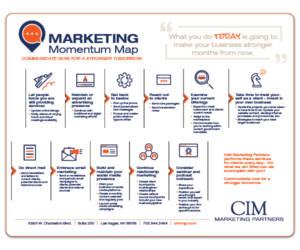
First, here is our Marketing Momentum Map that outlines important categories of efforts you can take to communicate with your clients or customers to plant seeds and build a stronger tomorrow. I challenge you and your team to integrate three tactics each week. Download here.
Away from your usual workspace, you may have found yourself sitting for long periods of time at your computer. One of my team members, Kerry, developed a list of quick and easy exercises to keep our team moving and motivated throughout the day. Give them a try and discover that even an hourly, one-minute break can make a world of difference. Here’s all you have to do:
WORKOUT MENU: Choose one exercise each hour of your workday and do it for one minute. Set your alarm to get out of your seat and get moving:
- Squats (if you have knee issues, sit in a chair and stand up)
-
High plank with shoulder taps (alternate right/left – keep feet apart for stability)
-
Situps + toe reach (extend your legs long and reach your fingertips to your toes)
-
Burpees (step out and in if jumping doesn’t work for you)
-
Pushups (do on your knees if needed)
-
Jumping jacks (do a squat at the bottom of your jacks for higher intensity)
-
Abdominal side twists (feet off the floor for higher intensity)
-
Tricep dips (use a coffee table or stairs or chair for elevation)
Sending positive thoughts your way...
Quote of the week:
“A positive attitude gives you power over your circumstances instead of your circumstances having power over you.”
|
I hope this message reaches you in good spirits, with you, your family and colleagues doing well and staying healthy.
Here’s a little scenario you might find familiar: As you look at your work or business, you routinely say to yourself or discuss with your team, “Yes, we need to do that.” It could be that you note the need to work on your website, updating/cleaning up your business contact database, filing the pile of papers, organizing the files on your computer/server, or perhaps that you need to have your employee handbook updated.
Since we’re always focused on our clients and their needs first (it’s our first nature!), our own companies’ projects become postponed. Starting today, I encourage you to take a few minutes to recall some of those “forgotten” projects and start the ball rolling to tackle some of them now. Here is a mini-list to help you start:
- Update your website verbiage/content. Have you added new products or services? Is your client or service portfolio current? Do you need to add video content? Do your testimonials reflect your great work and accomplishments?
- Have you added new services or products that need to be promoted on your website and via tangible marketing materials?
- Ask your team to update their bios or profiles, both on your website and on their social media platforms, like LinkedIn.
- Look at your internal operations. Have you needed written policy and procedure documents that you or your team could start crafting or updating?
- Does your office need organizing or do items need to be purged?
I am NOT implying that in our downturn you haven’t remained busy, perhaps much busier than usual. For some, workloads have increased significantly; for others (due to the nature of their usual work), it may have decreased. Creating a to-do list, like above, is the first step. Step two is asking for volunteers and support based on everyone’s abilities and current availability.
Accomplishing the task of “treating yourself as your number one client,” at least for some of your time, will strengthen your company and ultimately help in your endeavor to provide excellent service to clients you work with and attract new clients in the future.
Quote of the week:
"Almost every successful person begins with two beliefs: The future can be better than the present, and I have the power to make it so.”
|
Don’t Be a Focus Group of One
One valuable method of research is a focus group. While the purposes, processes and information collected varies per project, very generally, a focus group follows along these lines: A small group of specially-chosen people (perhaps 10) is assembled in a conference room to answer questions and have discussion about a company or organization and its products or services (existing or potential). Topics may include how they feel about the brand or a product, what may make them purchase, what they like or don’t like, etc. A professional facilitator leads the group discussion and keeps everyone on track, while carefully worded, non-leading questions are posed. The 60- or 90-minute session should lead to a bounty of information that can be used to help formulate, guide and steer marketing strategy and operations moving forward. Depending on the scope of the company or its operations, several focus groups may be performed, possibly in multiple markets and on an ongoing basis to track consumer changes.
In years of meeting with clients, every now and then, we encounter someone who could be characterized as a focus group of one. Here’s how it goes down: We have a potential marketing initiative to consider, say, radio advertising. A particular radio station reaches the ideal demographic, has rates that fall within the budget, etc. In short, radio advertising may be a very good part of an overall strategy. The client says, “But I don’t listen to radio. Why would I want to advertise there? Let’s not do that.” There’s a disconnect, not understanding that you may not “be” everywhere your customers are. Similarly, you may not read the local business publications, but your customers may. Sure, it’s fair and important to have a discussion about any particular marketing initiative to rule it in or out as one to implement.
What to do? Simple. Trust the guidance provided by your marketing and public relations professionals. They’ll help you cut through the clutter of what’s relevant and what will move the dial on growing your business. What not to do? Shut down an idea just because it wouldn’t work on you.
Always remember diversification. Your marketing mix should contain multiple initiatives working together to produce results, as measured by increased brand awareness and business activity, ultimately leading to increased value of the business and increased profits. Radio, or any other single initiative, is worthy of consideration beyond the focus group of one.